What Does a Low-Grade Migraine Feel Like? (And How Do You Actually Work Through One?)
You are sitting at your desk. You have been trying to read the same email for 20 minutes. You got to the third paragraph, lost the thread, went back to the top, and lost it again. You look fine. Nobody in the room would guess that anything is wrong. But you are running at about 40%, and everything feels like it is happening through a layer of fog.
This is what I call a working migraine.
Not a full vampire day. Not the kind that sends you to a dark room with a cold pack and no phone. The kind where you are technically present, technically functioning, and technically fine, except that nothing is actually fine and everything costs twice as much energy as it should.
If you have experienced this and wondered whether it counts as a real migraine, then I’m happy to report it does, so at the very least, you now know what’s going on. And if someone has ever questioned whether you are actually having a migraine while you are still sitting upright and answering emails, you are not alone in that either.
What is a Low-Grade Migraine?
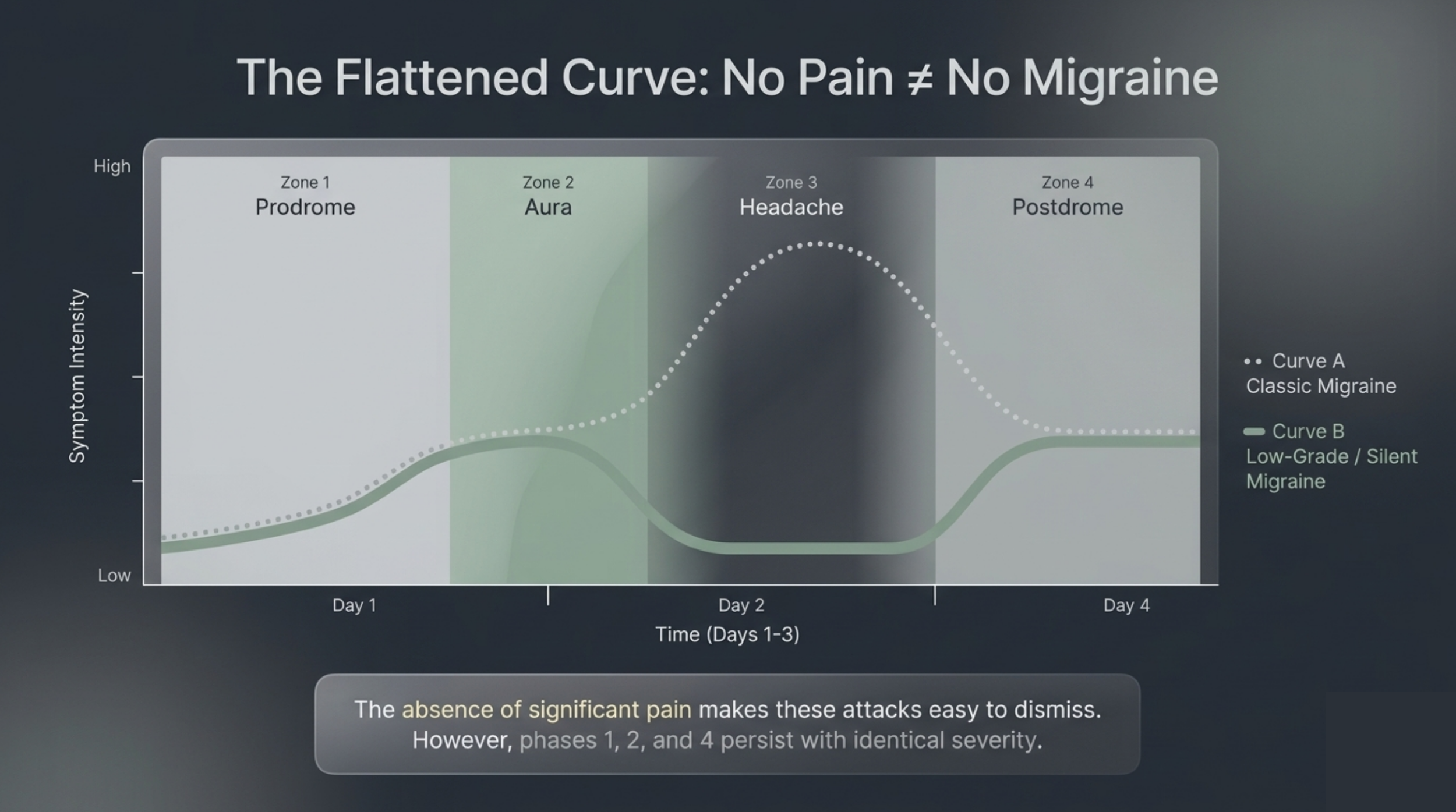
A low-grade migraine is not a different condition. It is the same neurological event as a full migraine attack, presenting at a lower intensity. All four phases, prodrome, aura, headache, and postdrome, can still occur. The headache phase may be mild, dull rather than sharp, manageable rather than incapacitating. But the other phases are very much present, and they still have real effects on how you think, move, and function.
The term “functional migraine” is sometimes used colloquially to describe attacks where you can still function. The word functional does not mean minor. It means you are still upright. The cognitive load, the sensory sensitivity, the nausea, the fatigue, all of it is still there. You are just carrying it quietly.
What is a Migraine Without a Headache?
This is where it gets more complicated and more important.
Not all migraines involve headache pain. Clinically, this is called “migraine aura without headache.” You may also see it referred to as a silent migraine, though the American Migraine Foundation notes that “silent migraine” is no longer the preferred term, because the word silent may send the wrong message about what the person is actually experiencing.
According to research published in Current Pain and Headache Reports, typical aura without headache occurs exclusively in 4% of people with migraines, and may occur at some point in up to 38% of people who experience migraine with aura.

This matters more than most people realise.
I take daily preventive medication that does a good job of reducing the frequency of my migraines with headache pain. What it does not do is prevent the aura-based attacks, the ones where all the other symptoms are present, and the head pain itself is absent or minimal. For years, I did not recognize these as migraines because I had accepted the general consensus of what a migraine is: migraines are severe headaches. If there is no severe headache, it is not a migraine.
When I finally understood what was actually happening, I more than doubled the number of migraines I had recorded. That shift, from thinking I had occasional severe migraines to understanding I had chronic, almost daily migraines, changed everything about how I managed the condition and how I talked about it with my doctor. If you have ever felt like your migraine count does not match the level of impact migraines have on your life, this might be why.
The Four Phases of a Low-Grade Migraine
Even in a low-grade or headache-free attack, all four migraine phases can be present.
The prodrome phase can begin hours or days before the attack itself. Mood changes, fatigue, neck stiffness, food cravings, and increased sensitivity to light or sound are all prodrome signals. On a working migraine day, I am often in prodrome before I realise what I am actually heading into.
The aura phase, if it occurs, involves neurological symptoms including visual disturbances, mild balance disruption, and sensory changes. In a low-grade attack, these may be subtle enough to question. That subtlety is not evidence that they are not happening.
The headache phase in a low-grade migraine may be mild or absent. The absence of significant pain is what makes these attacks so easy to dismiss, both for the person experiencing them and for people around them.
The postdrome phase, the migraine hangover, can still follow a low-grade attack. Fatigue, flat mood, brain fog, and lingering sensitivity can all appear even when the headache phase was minimal. Do not be surprised if a working migraine day is followed by a recovery day.
What does a Low-Grade Migraine Actually Feel Like?
The best way I can describe the physical experience of a working migraine is that my body is running the same software but on much less processing power, and some of the inputs are coming in distorted.
The pressure is dull rather than sharp. It is not the kind of pain that stops you. It is the kind that sits there persistently and makes everything else harder to do. My light sensitivity does not always reach vampire-day levels during these episodes, but bright screens feel sharper than they should, and overhead fluorescent lights become something I actively avoid rather than ignore.
My hearing becomes more sensitive. Sounds that I normally filter out automatically, background conversations, keyboard clicks, music from another room, register louder and more intrusively than normal. My brain is spending energy on things it usually handles automatically, and that leaves less for everything else.
The visual disturbances on a low-grade migraine day are different from a full aura. They can be subtle enough to wonder if you are imagining them. Colours and shades present slightly differently, not enough to be a major issue, but to the point where I can’t complete any design tasks at work that day. There is a quality to the light that feels off in a way that is hard to articulate. Mild flickering at the edges of my vision. The world looks technically normal, but something about it does not feel quite right.
My balance can shift. There are low-grade migraine days where walking feels like moving through sand, or like the ground has a very slight give to it, the way a bouncy castle feels underfoot. It is not dramatic. It would not be obvious to anyone watching. But every step requires slightly more attention than it should.
I am also sometimes slightly shaky. My hands, mostly. Nothing that would be visible to someone across a room, but noticeable enough that I am more careful with cups and glasses than usual, and typing suddenly becomes a battle of typos.
And underneath all of it, the fatigue. The kind that is disproportionate to what I am actually doing. Sitting at a desk should not be exhausting. On a working migraine day, it is.
What Working Through a Low-Grade Migraine Actually Looks Like
This is the part nobody talks about, because from the outside, there is nothing to see.
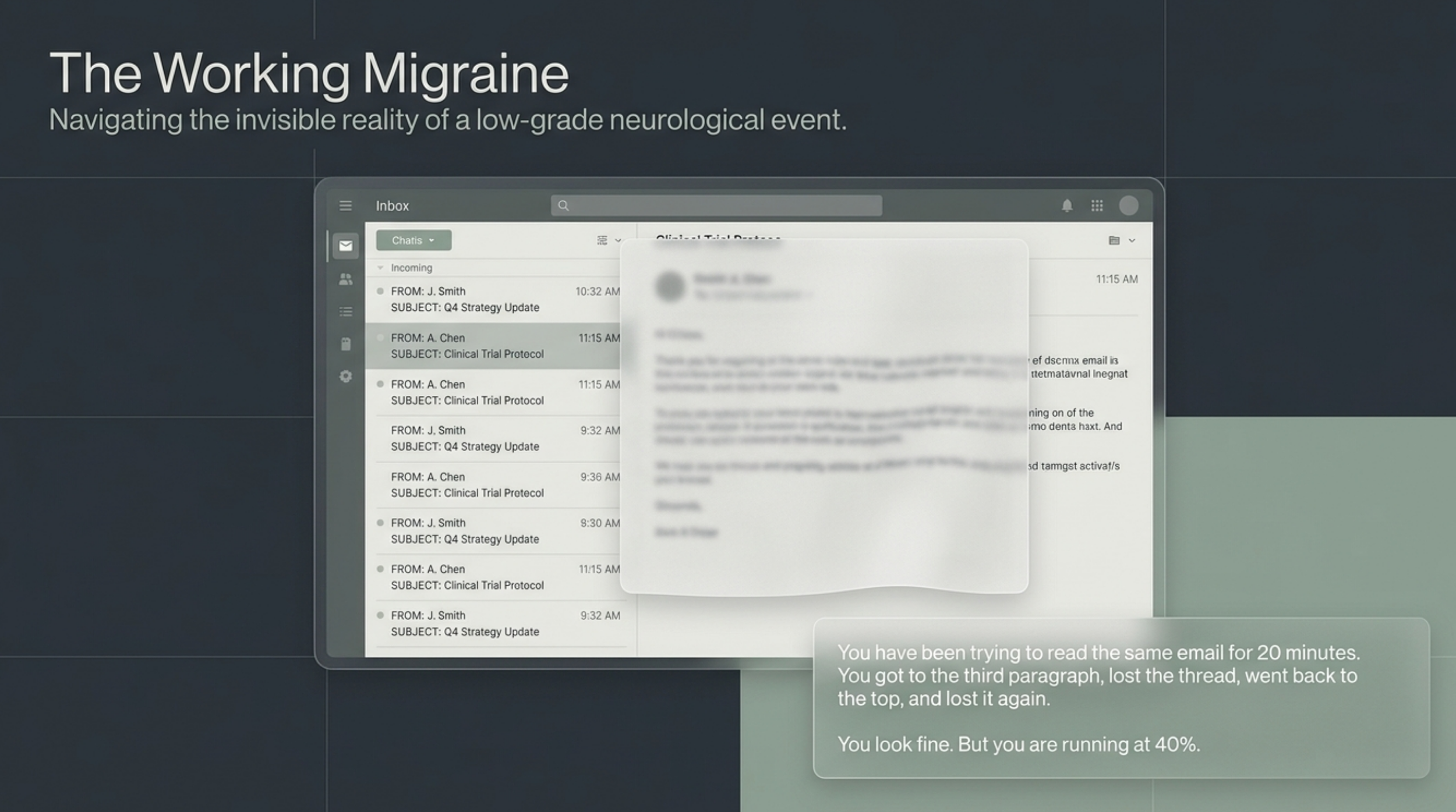
I have spent 20 minutes reading and re-reading the same email, not because the content is complex, but because the sentence I just finished reading is gone from my mind by the time I reach the next one. I forget things mid-sentence. I lose the thread of a task I was in the middle of. Halfway through writing something, I will look up and genuinely not remember what point I was trying to make.
Tasks that are part of my normal daily routine, things I do on autopilot, suddenly require conscious effort and active thought. Not because they are hard. Because my brain is running at reduced capacity, it is allocating that capacity unevenly.
I keep a notebook on my desk during these episodes. Not to take notes in the traditional sense, just to leave myself anchors.
What am I working on right now?
What is the next step?
What was I about to do before I looked up?
It is a workaround, but it helped more than I expected the first time I tried it.
There is also the social dimension. I am a natural introvert who has learned to perform extroversion at work. Under normal circumstances, I can do that well. During a working migraine, the idea of having to put on that face, to be present and engaged in a conversation, to make eye contact and track what someone is saying, and respond coherently in real time, feels genuinely impossible. Not difficult. Impossible. I manage it because I have to, but it costs more than most of my colleagues would ever guess.
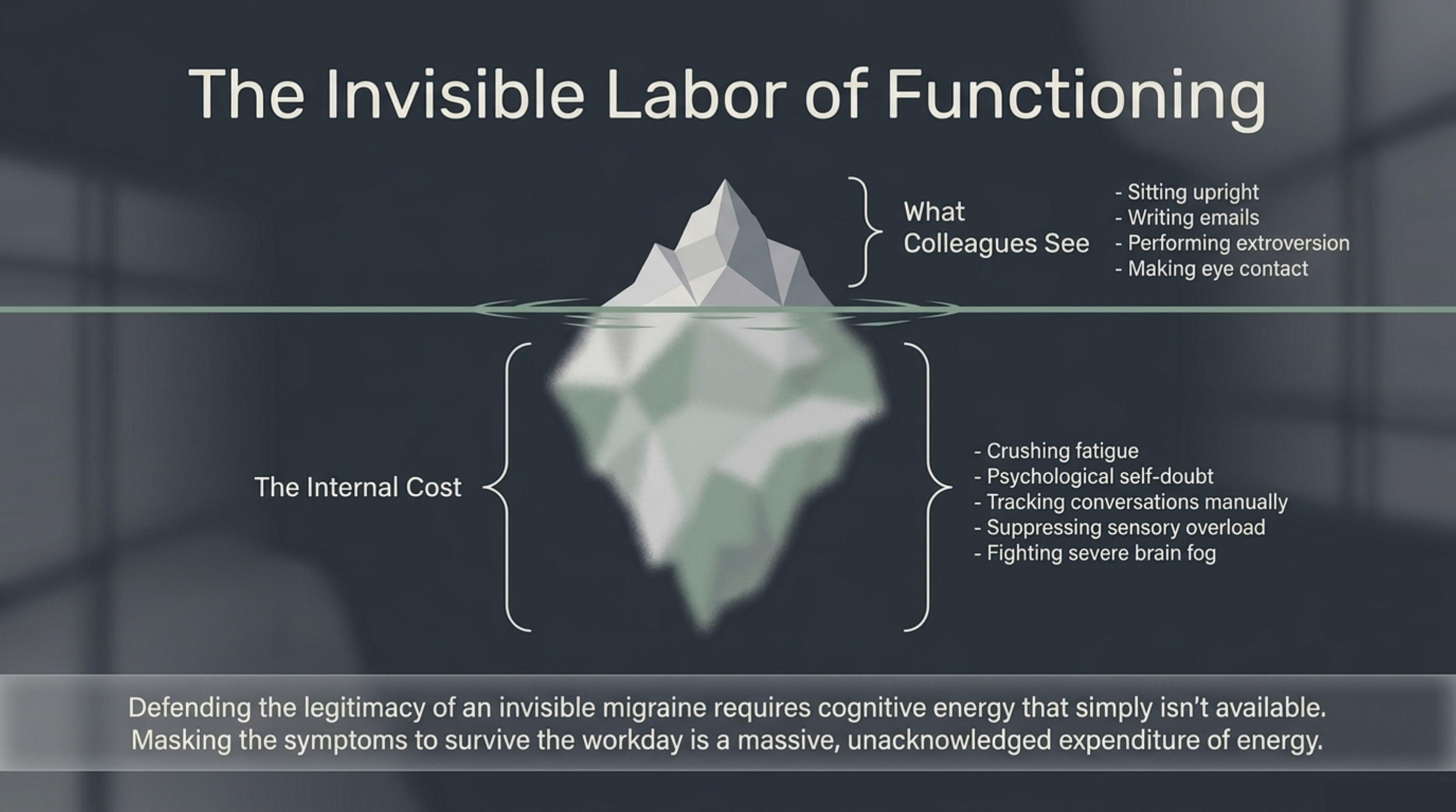
I will also adjust everything I can within the environment. Lower screen brightness. Close the blinds. Find a quieter space if one is available. Move meetings if I have any flexibility. Stick to tasks that do not require creativity or analytical thinking, administrative work, straightforward tasks with clear steps, anything that runs on routine rather than original thought.
What I do not do is mention it.
Not because I am ashamed of it. But because there are no external symptoms and the conversation that follows is rarely worth having on a day when my brain fog means I can easily become confused. Defending the legitimacy of a migraine I am experiencing while simultaneously trying to manage the cognitive effects of it adds a layer of difficulty I simply do not need. I have learned to manage what is happening quietly and protect my capacity for the work that needs doing.
The Invisible Problem: When People Question Whether it is Real
Here is something that took me a long time to separate from my own self-assessment of these attacks.
When someone asks, “are you sure it is actually a migraine?” while you are still sitting upright and apparently functioning, it lands differently than they probably intend. Because I am already asking myself the same question. The brain fog that comes with a low-grade migraine makes me more susceptible to self-doubt, not less. My thinking is slower and less certain. Introducing doubt while in that state is genuinely destabilising.
For a long time, the cultural image of a migraine I constantly saw was someone in so much pain they needed emergency hospital treatment. That image is real and valid. But it is only one end of the spectrum. The fact that migraines can present as a low-grade migraine, as a mostly invisible cognitive impairment with mild physical symptoms and no dramatic pain, does not make that presentation less real or less significant.
What made the biggest difference to my own understanding was finally recognising my silent migraines as migraines. Not minimising them, not treating them as something less, not waiting until the head pain arrived to count it. They were always there. I just did not have the language for them.
It is a migraine. You are not imagining it. And you are not making it up to avoid things.
Adjustments that Help During a Working Migraine
You will not stop the attack by working around it, but you can reduce the load on your nervous system while it is happening.
Reduce light wherever you can. Screen brightness down, blinds closed, avoid overhead fluorescent lighting if there is any flexibility in where you sit or work.
Move or reschedule mentally demanding tasks. Anything that requires original thinking, creative problem-solving, or complex analysis is best deferred. Routine, clearly defined tasks are much more manageable.
Use a notebook as a cognitive anchor. Writing down what you are doing and what comes next reduces the mental load of tracking your own progress when your memory is unreliable.
Lower the social demands on yourself where possible. If you have meetings that are not essential, move them. If you need to attend, give yourself permission to be quieter than usual.
Stay on top of hydration and eat consistently. A low-grade migraine is still a migraine. The same rules about not allowing dehydration or fasting to add to your threshold load apply just as much here.
Reach for non-medication interventions: adjusted lighting, reduced sound, a cold pack if there is any pressure, peppermint oil in a diffuser if you are somewhere you can use one.
Monitor whether the attack is escalating. A low-grade migraine that is managed and stable is one situation. One that is building toward a full attack is a different situation that requires a different response.
Knowing When to Stop
I have a clear line with all my migraines, and I do not cross it.
If an aura develops or my vision is significantly impaired, I stop. Full stop. Not because it is uncomfortable, but because it is not safe. Driving with a developed aura is not safe. Making decisions that affect other people when my vision and cognition are significantly impaired is not responsible. The work can wait.
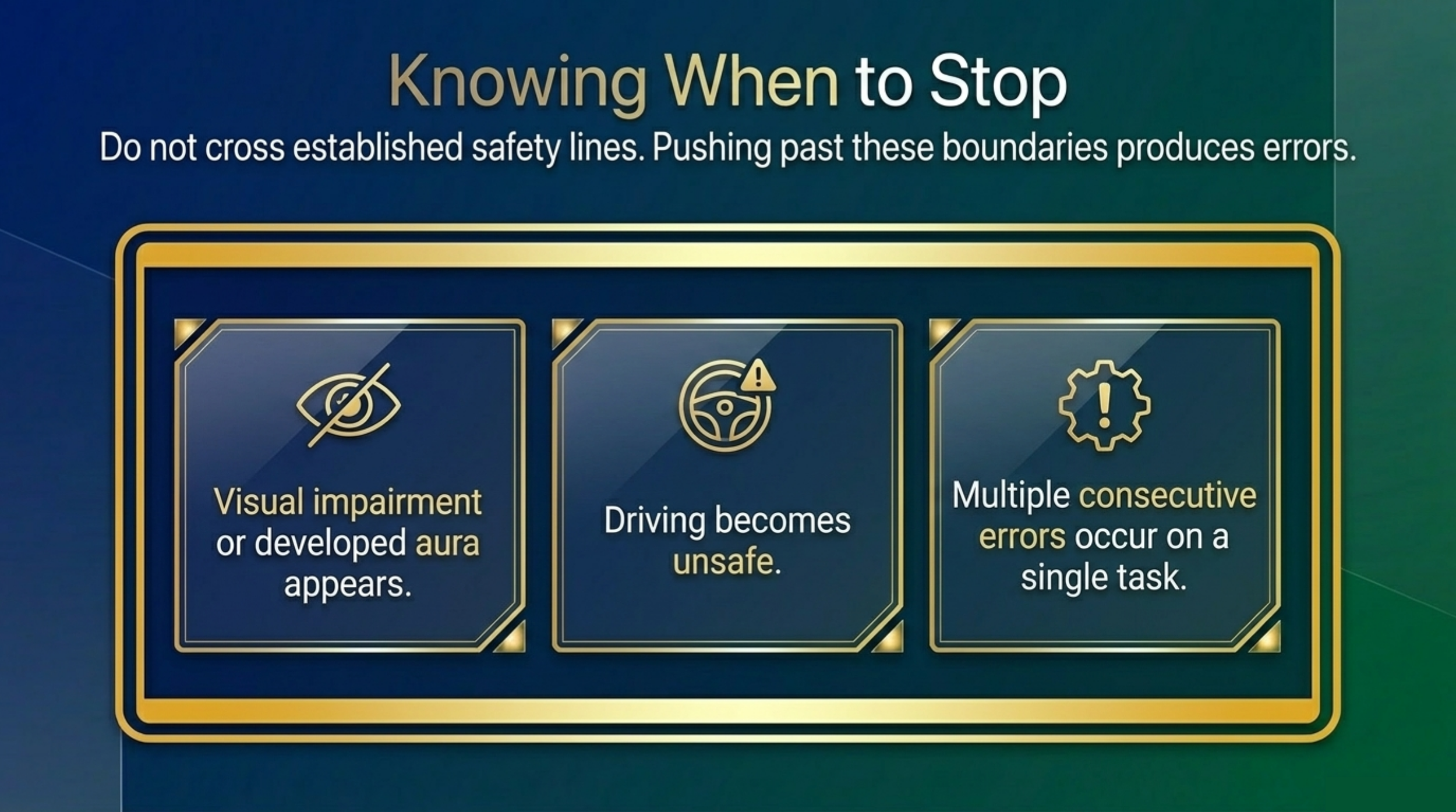
Multiple consecutive mistakes on a single task are the other signal. If I notice I have made the same error more than once, or I cannot hold the thread of what I am doing long enough to complete a basic step, I pause that task and come back later. Pushing past that point does not produce useful work. It produces work that will need to be fixed.
One important note: some symptoms of migraine aura without headache overlap with symptoms of stroke, including visual disturbances, difficulty speaking, and numbness. The Cleveland Clinic notes that if any of these symptoms feel more intense than your typical migraine experience, you should seek emergency care rather than waiting to see if it passes.
If something feels different from your normal pattern, treat it differently.
FAQ
-
A low-grade migraine feels like functioning through a layer of interference. Brain fog and slower thinking, dull pressure rather than sharp pain, mild light and sound sensitivity, nausea that comes and goes, and fatigue that is disproportionate to what you are doing. Balance can feel slightly off. Visual disturbances may be subtle, colours and shades presenting slightly differently, and mild flickering at the edges of vision. You look fine. You are not fine. You are just managing it.
-
Yes. Clinically, this is called migraine aura without headache, sometimes referred to as a silent migraine, though the American Migraine Foundation notes that “silent” is no longer the preferred term because it minimizes the experience. All other migraine phases and symptoms can be present without headache pain. Research suggests this type of migraine occurs exclusively in around 4% of migraine sufferers and may occur at some point in up to 38% of those who experience migraine with aura. If you have migraines and find that some of your attacks do not involve significant head pain, they are still migraines and still worth tracking and discussing with your doctor.
-
No. Migraine is a neurological condition that affects far more than head pain. It involves the brain, the nervous system, and multiple body systems. Symptoms include cognitive impairment, sensory disturbances, nausea, balance disruption, fatigue, and mood changes, many of which can be present without any headache at all. Reducing migraine to a bad headache is one of the most common misconceptions about the condition, and one of the reasons a migraine without headache goes unrecognised for so long in many people.
-
Sometimes, depending on the severity of the attack and the nature of the work. During a low-grade migraine, working is possible with significant adjustments: reducing sensory load, deferring cognitively demanding tasks, using tools like a notebook to compensate for impaired short-term memory, and monitoring closely for escalation. What you cannot do is work at normal capacity. Everything takes longer, costs more, and carries a higher error rate. The question is not just whether you can work, but whether you should be working, and if the work being produced is up to the standard it needs to be.
-
When an aura develops or vision is significantly impaired, stop. It is not safe to drive or make consequential decisions in that state. When you are making multiple consecutive errors on a task, stop and return to it later. When the attack is clearly escalating rather than holding steady, stop and treat it as a full attack rather than a silent migraine. The goal of working through a low-grade migraine is to manage it while it is stable. Pushing through escalation does not make you more productive. It makes the recovery longer.
-
Migraine aura without headache is a recognised neurological phenomenon with the same underlying mechanism as migraine with headache, cortical spreading depression, a wave of electrical activity moving across the brain’s cortex. For some people, it is their primary migraine type. For others, it develops over time or occurs alongside pain-based attacks. Some preventive medications reduce pain-based migraines without affecting aura-based ones, which means the headache-free attacks can persist or even become more noticeable as the painful ones become less frequent. If this sounds familiar, it is worth talking with your neurologist directly about it.
-
A low-grade migraine refers to an attack with mild symptoms across the board, including mild head pain. A silent migraine, or more accurately migraine aura without headache, refers specifically to an attack where aura is present but head pain is absent or minimal. Both involve the same neurological process. The key distinction is whether head pain is present at all. Both are real migraines. Both affect daily functioning. Both are worth tracking and discussing with your doctor.
Ready for More?
If a working migraine hits and you need practical strategies for managing it at home or in the moment, the migraine relief at home post covers what to reach for, in order, when an attack is building. A full post on managing migraines specifically in a work context is coming to the blog soon.
QUICK ANSWER: A low-grade migraine is a migraine attack where symptoms are present but have not reached full intensity. You can still function, but everything is significantly harder. Brain fog, dull pressure, mild sensory sensitivity, fatigue, and nausea can all be present without the acute, debilitating pain of a full attack. It is a real migraine. The absence of severe pain does not mean the absence of a neurological event.
