What Is a Migraine Hangover (Postdrome)? Symptoms, How Long It Lasts, and How to Actually Recover
You woke up, and the pain is gone. You should feel relieved. You do, a little. But your body still feels like it lost a fight. Your brain is wrapped in fog, your muscles ache, and the idea of looking at your phone screen for more than 30 seconds feels genuinely ambitious.
Welcome to the migraine hangover.
If you have never heard that term before, you are not alone. The clinical name for it is postdrome, but I have never really connected with that word. It feels too clean for what it actually is. I’ve always called it a migraine hangover because every time I’ve tried to describe what I’m feeling to someone who has never had a migraine, I’ve always gotten blank looks when I use the term postdrome, but they always immediately seem to understand when I call it a migraine hangover. Because everyone understands what a hangover is, whether they’ve experienced one themselves or just seen it depicted in media, but most people have never heard of postdrome.
What is a Migraine Hangover?
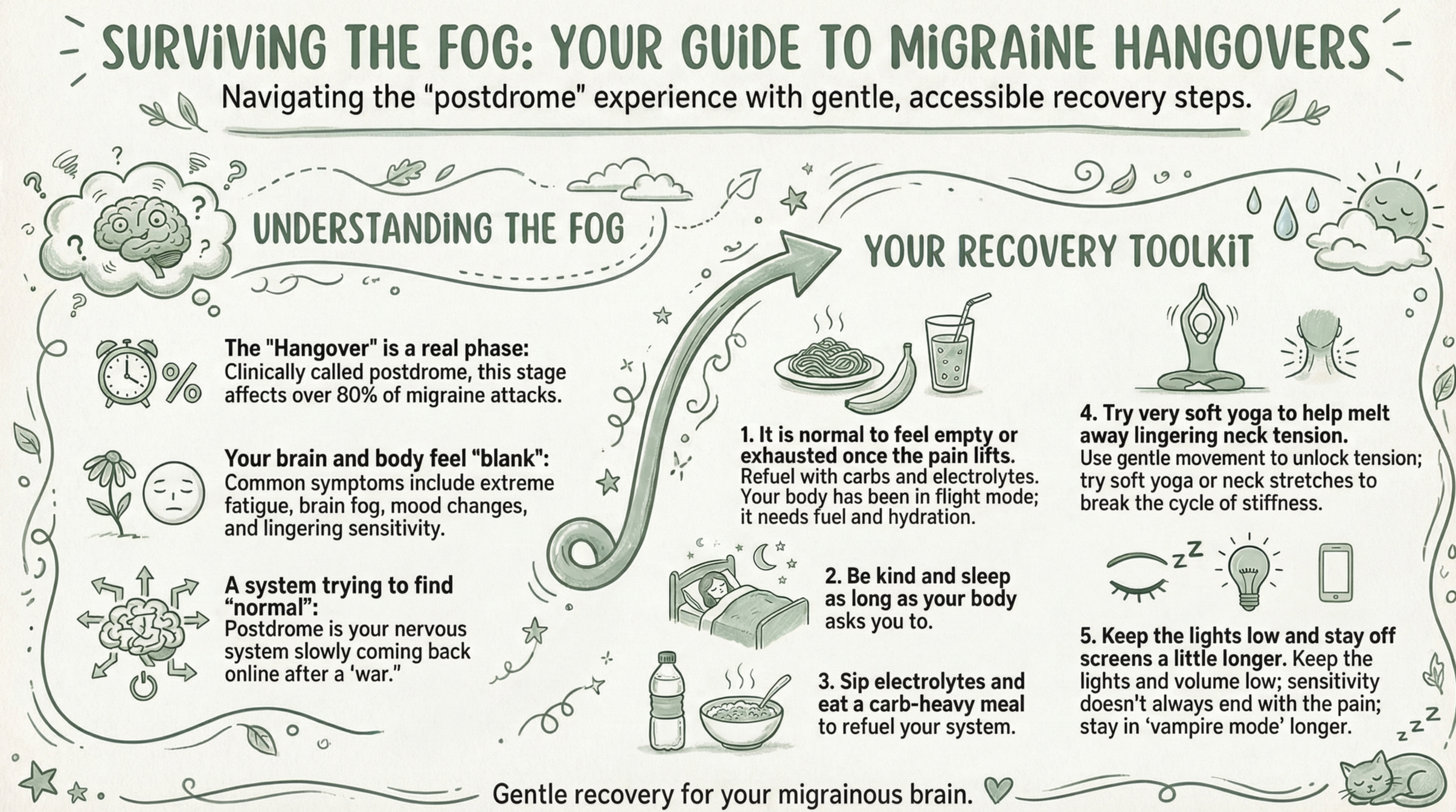
A migraine moves through four phases: prodrome (the warning signs), aura (for those who experience it), the migraine phase, and postdrome. The migraine hangover is that fourth phase. It is what happens after the pain lifts, when your brain and body are technically past the worst of it but have not fully come back online yet.
The term postdrome comes from medical literature, but many migraine sufferers have taken to using the term migraine hangover to describe it because that is exactly what it feels like. Your head is no longer pounding, but you are absolutely not okay.
With more than 80% of migraine attacks being followed by postdrome symptoms, that means the majority of people living with migraines are dealing with this phase regularly, and most of them have never had it named for them.
What Does a Postdrome Feel Like?

The best way I can describe my postdrome phase is this: my brain and nervous system just conducted a war on my body, and there is no real winner.
The pain is gone, but everything else lingers. There is a specific kind of exhausted that comes after a bad migraine that is different from being tired. I can sleep 12 hours during an attack and still wake up feeling like I have not slept at all. My mood is flat. Not sad exactly, just empty. The light sensitivity that had me living like a vampire for the past day does not just switch off the moment the headache does. Everything still feels one notch too bright, one notch too loud.
Then there is the hunger. On the good recoveries, when my medication has done its job properly, my body seems to suddenly recognise that it is no longer in flight mode. The hunger hits like a bear waking up from a winter hibernation. My body remembers it needs fuel, and it wants all of it immediately.
That version of postdrome is manageable. Rest, food, water, sleep. Back to normal within a day.
The harder version is something else entirely.
What are the Symptoms of a Migraine Hangover?
Postdrome symptoms vary from person to person and from attack to attack. The most common ones I experience include:
Extreme fatigue, even after sleeping for many hours
Brain fog and difficulty concentrating
Mood changes, including feeling flat, low, or emotionally drained
Lingering light sensitivity
Lingering sound sensitivity
Muscle aches and stiffness, particularly in the neck and shoulders
Nausea that carries over from the attack itself
Intense hunger or food cravings
Mild residual head pressure or discomfort (not a full headache, but not nothing either)
Dizziness
Research from the Cleveland Clinic confirms fatigue, body aches, difficulty concentrating, and mood changes as the most frequently reported postdrome symptoms. What the clinical lists do not always capture is how these symptoms interact. The brain fog makes the fatigue feel worse. The lingering light sensitivity makes it harder to rest properly. It is important to remember that this isn’t one symptom; it is a system that has been through something and is slowly trying to find its way back to “normal”.
How Long Does a Migraine Hangover Last?
The honest answer: it depends on the attack.
For milder migraines or ones where medication worked early and effectively, postdrome can resolve within a few hours or by the following morning. Sleep, a proper meal, and hydration go a long way. For a low-grade migraine and the working migraine experience, the postdome phase often feels like a deep brain fog.
For more severe attacks, or ones where medication did not land properly, postdrome can stretch into two days or more. A study published in Neurology found that in 93% of attacks, postdrome resolved within 24 hours after the migraine ended, But that leaves a meaningful percentage of attacks where recovery runs longer, and for those of us with chronic migraines experiencing 15 or more attacks per month, those longer recoveries stack up and lead to months where there are no real good days, just says with differnt stages of a migraine.
The severity of the migraine itself is a factor, but it is not the only one. How early you treated it, whether you were able to rest properly during the attack, your hydration levels during the attack, and your stress load all play a role in how long the hangover phase runs.
When Your Medication Works vs. When it Does Not
When medication works as it should, postdrome is still real, but it is survivable. The pain lifts, the hunger arrives, and the fatigue is deep but manageable. You can sleep it off. You might need another rest day, but you can easily come back and move forward.
When medication does not work, or does not work fast enough, the postdrome is a different situation entirely. The nausea does not clear with the migraine. Light sensitivity stays so heightened that a screen or a window can threaten to pull you back into a full attack. You are not recovering, you are negotiating. Can I drink ginger ale without triggering the nausea? Can I eat crackers? I know fasting will bring on another migraine, so I have to eat something, but everything feels like a gamble.
My goal in that state is to gently coax my body out of flight mode and back into something approaching survival mode. Slowly building up to eating crackers, and if possible, a smoothie. Slow, careful movement when lying still feels like it is keeping the tension locked in. I spend that recovery period listening very carefully to what my body is asking for, because pushing in the wrong direction risks a relapse migraine, and a relapse migraine after an already brutal attack, in my opinion, is one of the hardest things to come back from.
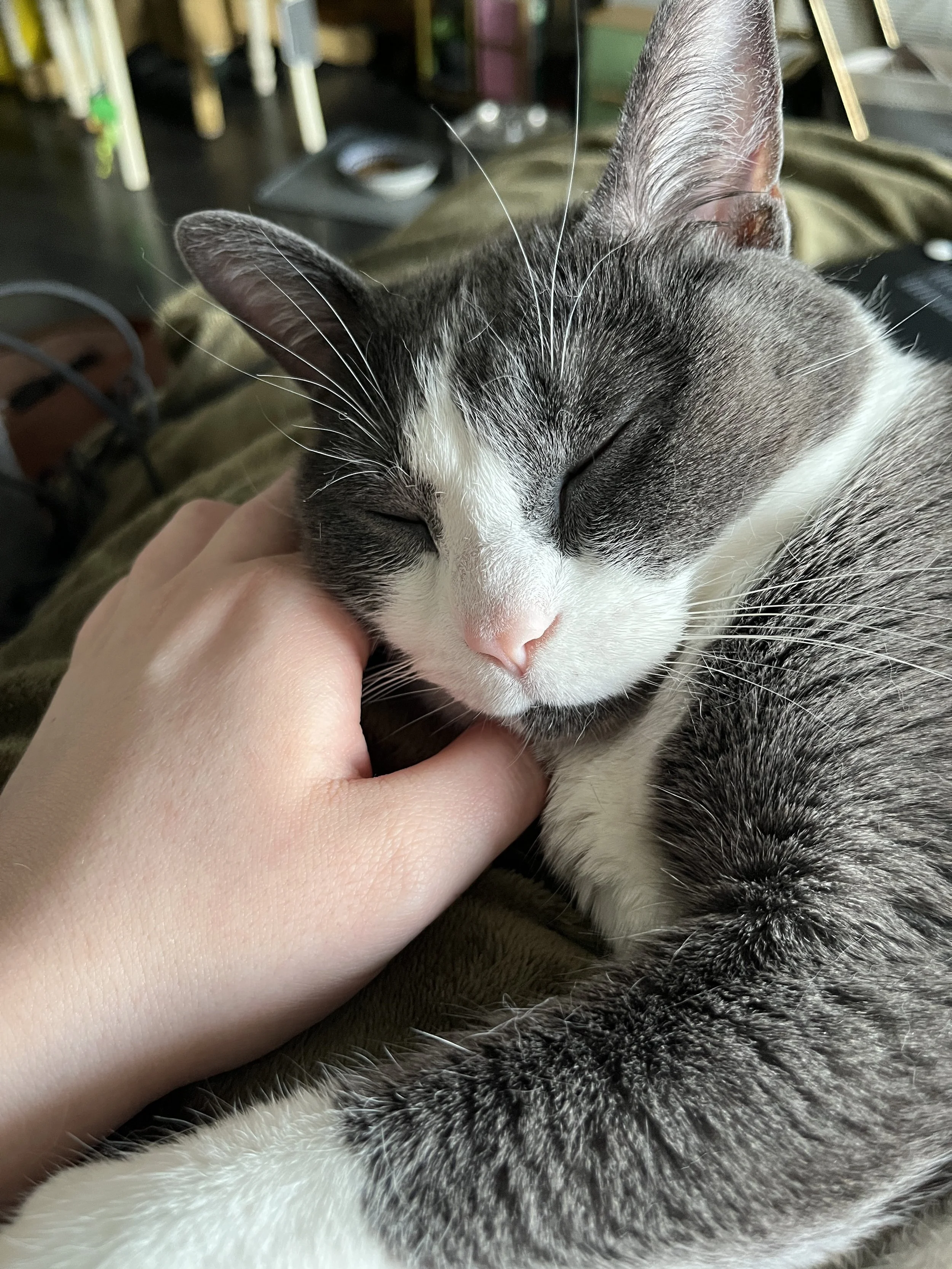
Even when I don’t want to rest, Jerri make sure I do.
How to Recover From a Migraine Hangover
Recovery looks different depending on which version of postdrome you are dealing with.
For a milder postdrome:
Sleep as much as your body is asking for. This is not laziness; it is recovery.
Hydrate steadily. Water and electrolyte drinks both help. Dehydration is one of the fastest ways to extend a migraine hangover or invite another attack.
Eat a real meal. Something carb-heavy tends to work well. Your body has been running on nothing, and it needs fuel to get back to baseline.
Keep light and sound low for a few more hours even after the migraine lifts. The sensitivity does not always end when the pain does.
Avoid screens if you can, or reduce brightness significantly if you cannot. I’ve found switching to dark mode helps.
For a more severe or lingering postdrome:
Start with what your stomach will accept. Ginger ale, crackers, plain toast. The goal is to get something in without triggering nausea.
Move to a smoothie when you are ready (and only when your sensitivity to sound has decreased or if you can use earplugs). Something easy to digest that gives your body calories and nutrients without asking too much of your digestive system.
When the muscle tightness sets in, which for me tends to happen in the neck and shoulders, gentle movement helps break the cycle. Not exercise. Gentle, slow movement.
Yoga has been one of the most useful tools in my postdrome toolkit.
For neck and shoulder tightness specifically, this video has helped me more than once: https://youtu.be/X3-gKPNyrTA?si=rKkgc5gZtug2zaZf.
For a more general migraine relief practice when the whole body feels locked up, I use this one: https://youtu.be/QFkAl5wHEbg?si=AV_6wq6s8vCmTfLy
The goal with movement is to release the physical tension that, if left alone, can become the trigger for the next attack. You are not trying to feel better immediately. You are trying to interrupt the cycle.
The American Migraine Foundation also recommends avoiding known triggers during postdrome, since your nervous system is still in a heightened state even after the migraine resolves.
Can You Prevent a Migraine Hangover?
Unfortunately, you can’t prevent the migraine hangover without preventing the migraine itself.
Research from Neurology has found that the type of medication taken during the attack does not consistently reduce postdrome duration. So while treating your migraine early and effectively gives your body the best chance at a smoother recovery, there is no specific treatment that targets postdrome directly.
What does help is giving your body the best possible conditions to recover. That means treating the migraine as early as possible, staying hydrated through the attack, not pushing through symptoms before you are actually ready, and protecting yourself from triggers during the recovery window when your system is still sensitive.
The Migraine Trust has useful guidance on managing the full migraine cycle, including recovery.
When to Talk to Your Doctor
Postdrome is a normal part of the migraine cycle, but there are situations where it is worth talking about it with your neurologist or doctor:
Your postdrome regularly lasts more than 48 hours.
The recovery period consistently triggers a new migraine.
Your symptoms during postdrome feel severe or unusual compared to your normal pattern.
You are finding that postdrome is significantly affecting your ability to function at work or in daily life.
If you are managing chronic migraines and postdrome is a regular part of your experience, it is worth documenting it in your migraine diary. Tracking patterns around what helps, what makes it worse, and how long it typically lasts gives your doctor far more to work with than a general description.
FAQ
-
Yes. The migraine hangover is a recognised phase of a migraine, referred to medically as postdrome. Research published in Neurology found that it follows more than 80% of migraine headaches. It is not just tiredness after a bad migraine. It is a distinct phase of a migraine with its own set of symptoms that can be just as disruptive as the migraine itself.
-
There is no single fix, and recovery depends on how severe the attack was. For milder cases, rest, hydration, and a proper meal are usually enough. For more severe postdrome, the approach needs to be more careful: starting with easy-to-digest food and fluids, adding gentle movement like yoga to release muscle tension, and protecting yourself from triggers while your nervous system is still sensitive. The goal is to support recovery without pushing your body back toward another attack.
-
They can, yes. Dehydration is a common factor in both triggering migraines and prolonging recovery. Electrolyte drinks help replace what your body has lost, particularly if you experienced nausea or vomiting during the attack. Plain water is always the starting point, but adding electrolytes can support a faster return to baseline. Avoid anything with high sugar content or artificial ingredients if your stomach is still sensitive.
-
It can, and this is one of the most frustrating parts of managing chronic migraines. If you push through postdrome before your body is ready, ignore lingering light or sound sensitivity, fast for too long, or do not stay on top of hydration, you are setting yourself up for a relapse migraine. Gentle pacing, consistent eating, and protecting yourself from known triggers during the recovery window all reduce that risk.
-
It is not always easy to tell, especially in the early stages. Postdrome can include residual head pressure and sensitivity that feels uncomfortably close to the start of a new attack. Generally, postdrome symptoms are gradually improving over time, while a new migraine will feel like it is building. Tracking your patterns helps. If you know your postdrome typically lasts around 24 hours, and you are still feeling worse at the 36-hour mark, that is worth paying attention to. When in doubt, treat it as though another attack is possible: rest, protect yourself from triggers, eat and hydrate, and contact your doctor if you are concerned.
Ready for More?
If this resonated, you are in the right place. Browse the blog for more honest, real-world content about living with chronic migraines, including what to do when they follow you to work, why they wreck your sleep, and everything in between.
QUICK ANSWER: A migraine hangover, also called postdrome, is the final phase of a migraine. It begins when the migraine pain ends, and your body starts to recover. It causes symptoms like fatigue, brain fog, mood changes, and lingering light sensitivity. According to the American Migraine Foundation, it affects approximately 80% of people who experience migraines. It can last anywhere from a few hours to several days, depending on the severity of the attack.
