Weather and Migraines: Why Barometric Pressure Triggers Attacks and What You Can Actually Do About It
Most migraine triggers come with at least some degree of control.
You can eat before you get too hungry. You can step away from a stressful situation, even briefly. You can reduce your screen time, skip the drink, and go to bed earlier. These are not always easy choices, but they are choices you can make to help prevent a migraine.
Unfortunately, the weather is not a choice you can make.
When a storm system rolls in and the barometric pressure drops, there is no stepping away from it. You cannot eat something to fix it or take a break from it. The trigger is everywhere, outside every window, through every wall, and it will stay there for as long as the system decides to stay. Some of my longest-lasting migraines and most relentless retriggered attacks have come from multi-day storms or back-to-back pressure systems rolling through without giving my nervous system time to recover between them.
That lack of control is what makes weather one of my most frustrating triggers to manage. This post is about understanding why it happens, what your options actually are, and how to prepare rather than just react.
What is Barometric Pressure, and Why Does it Affect Migraines?
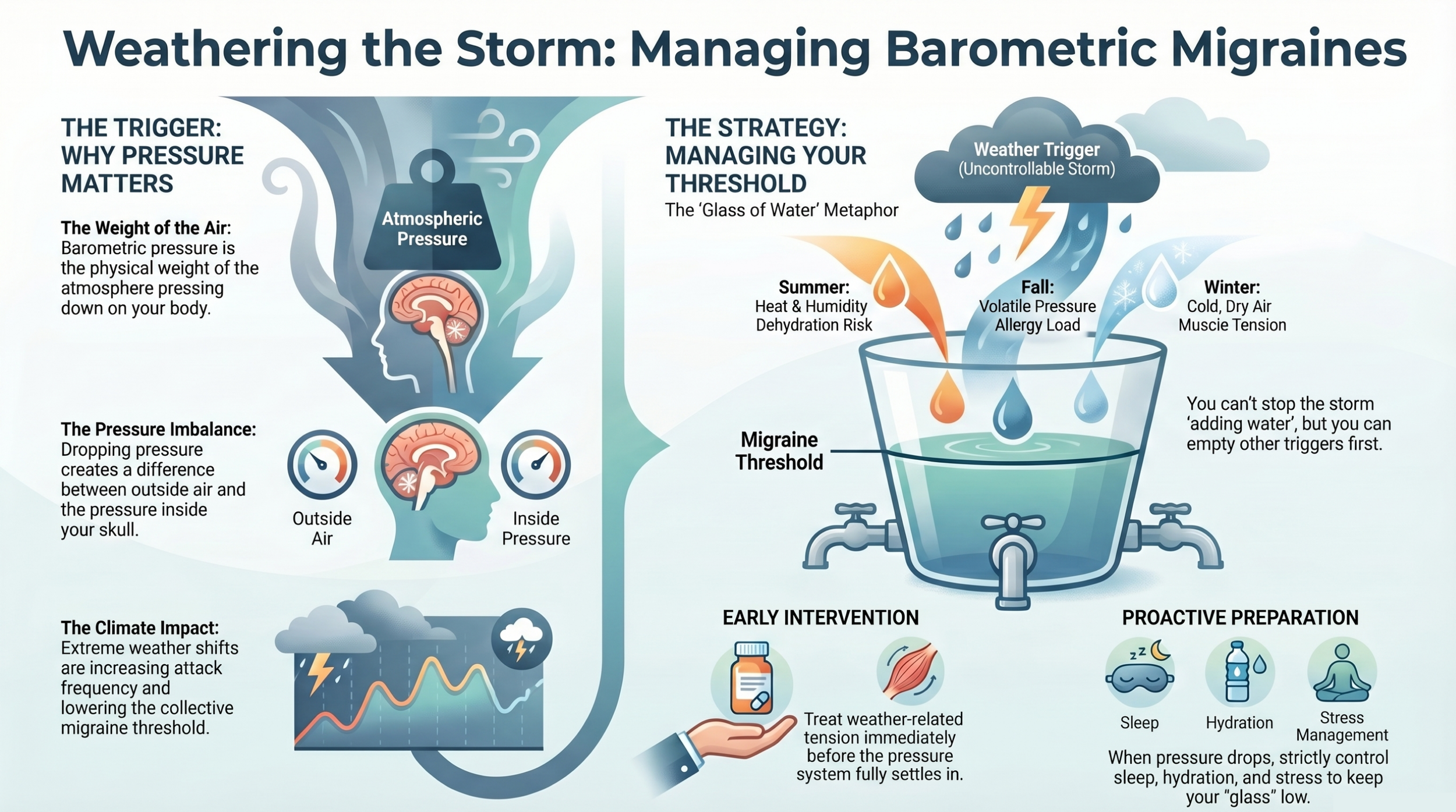
Barometric pressure is the weight of the air around you. It rises and falls depending on weather systems moving through your area. High pressure generally brings stable, clear weather. Low pressure brings clouds, rain, and storms.
When a low-pressure system approaches, the air around you becomes lighter. The leading theory is that this shift creates a small difference between the atmospheric pressure outside your head and the pressure inside your skull and sinuses. Your trigeminal nerve, the main pain-signalling nerve involved in migraines, picks up that change and responds by triggering the neurological cascade that produces a migraine attack.
It is worth being honest about what the research does and does not say here. The association between pressure drops and migraine is well documented, but the exact mechanism is not fully understood. A 2024 peer-reviewed review in PubMed confirmed that barometric pressure changes are well-established in the literature as a migraine trigger, while noting that the precise pathophysiology remains unclear:
What is clear is this: you are not imagining it. Your nervous system is genuinely responding to the weather.
What the Research Actually Says
Multiple studies confirm the relationship between pressure changes and migraine frequency. A 2023 study published in the American Migraine Foundation used data from a smartphone app tracking headaches among 4,375 adults and found that headaches were more common on days with higher humidity, more rainfall, and barometric pressure changes.
Another study from The Mayo Clinic notes that weather changes may trigger migraines by disrupting the balance of brain chemicals like serotonin.
While the Cleveland Clinic reports that pressure drops are the most consistently reported weather trigger, not everyone responds the same way. Some people are triggered by falling pressure, others by rising pressure, and some by rapid changes in either direction:
So essentially, the science says: weather sensitivity is real, it is variable between individuals, and the research supports it without fully explaining it. Knowing that your pattern is legitimate is the starting point for managing it.
Your Personal Weather Trigger Profile is Unique
Not every weather migraine sufferer responds to the same conditions. Understanding your specific pattern is more useful than a general list of weather warnings.
My personal pattern looks like this. A dropping pressure system before a storm is my most consistent trigger, often arriving before the clouds do. Sudden temperature swings, the kind that take you from a warm afternoon to a cold snap overnight, are a reliable second. High humidity in summer compounds everything, partly because of dehydration risk and partly because of how my body responds to heat. Flying and moving between different pressure environments can trigger an attack, particularly during descent. Seasonal transitions in spring and fall are high-risk periods, especially when the weather shifts back and forth rather than settling into the new season.
I also notice that I often feel the pressure change in my body before I check the forecast. A building tension across my forehead or at the base of my skull, a specific kind of heaviness that is different from regular tiredness, sends me to the weather app to confirm what I am already sensing. Over time, paying attention to that early signal has given me a small but meaningful window to prepare.
Migraine Canada has a useful overview of weather as a trigger and the individual variation in how it presents.
Season by Season: What Each One Brings
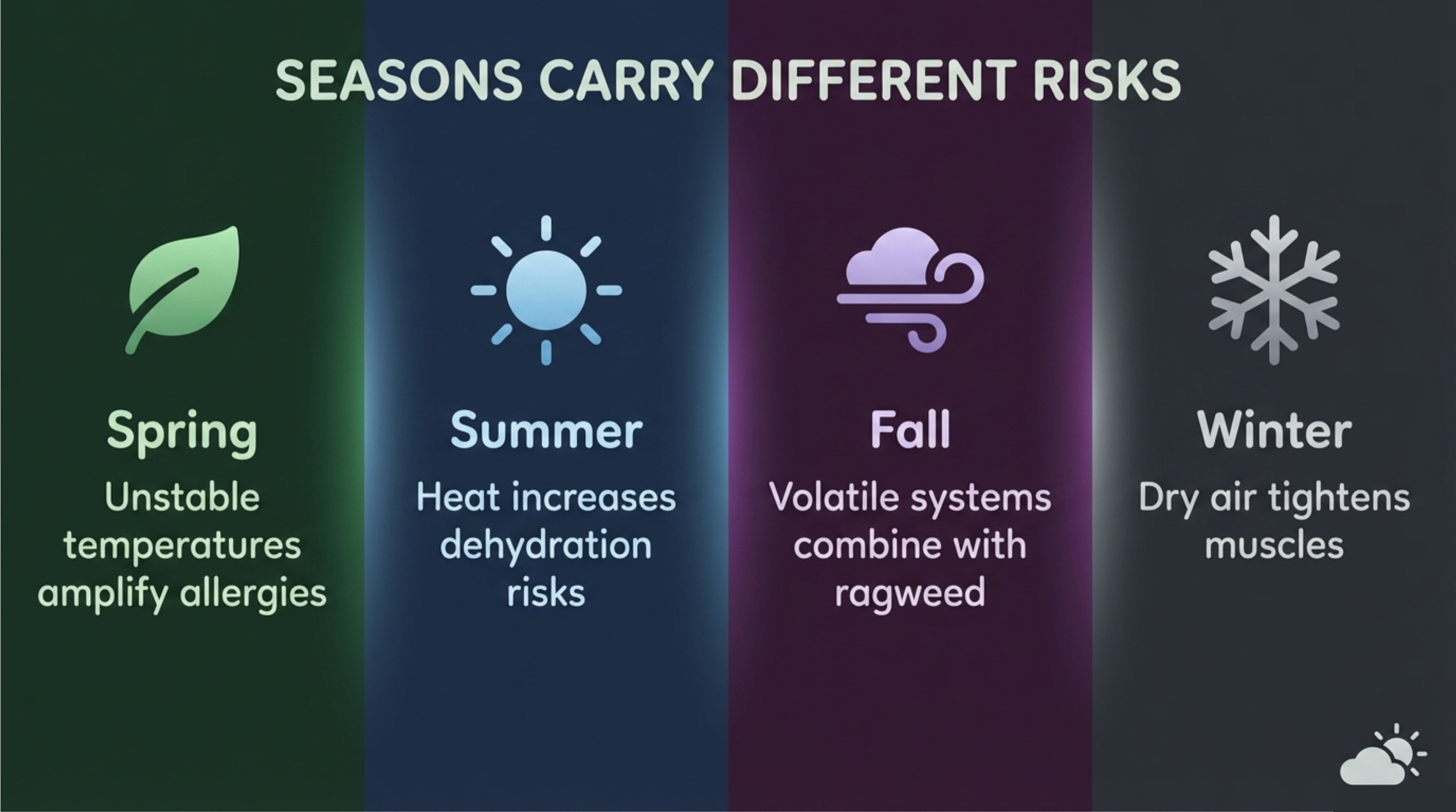
Weather triggers are not uniform across the year. Each season in Canada carries its own specific combination of pressures, and understanding the seasonal pattern can help you anticipate your highest-risk periods rather than being caught off guard.
Spring
Spring used to be the most predictable and difficult season. Pressure systems are unstable as the temperature fluctuates between winter cold and warmer air. Allergy season begins, and for anyone whose migraines interact with their allergies, the two systems start compounding each other. The challenge with allergy and weather triggers running together is that the symptoms overlap significantly. Sinus pressure, congestion, and sensitivity can look like migraine prodrome and also like allergy symptoms at the same time, making it hard to know what is driving what on any given day.
Summer
Heat and humidity are the dominant summer triggers. Research presented at the 2024 American Headache Society's Annual Scientific Meeting found that for every 10 degrees Fahrenheit increase in daily temperature, there was a 6% increase in headache occurrence.
For migraine sufferers specifically, summer heat compounds the dehydration risk, raises your baseline threshold, and makes sensory overload more likely. Bright sunlight, outdoor events, and changes between air-conditioned indoor spaces and humid outdoor air all add to the load.
Fall
Fall has become my hardest season. Ragweed peaks in September and October, adding a significant allergy load to everything else. Temperatures start dropping, and pressure systems become more volatile. The days shorten, light changes, and for those of us with any sensitivity to light quality, that shift is significant. Fall is when I am most alert to my baseline and most conservative about adding other triggers to the mix.
Winter
Cold dry air tightens muscles, particularly in the neck and shoulders, which, for tension-origin migraine sufferers, is a direct pipeline to an attack. Indoor heating strips moisture from the air, which contributes to dehydration if you are not compensating for it deliberately. And increasingly, Canadian winters are not the stable cold seasons they used to be.
Climate Change is Making this Worse, and the Research Agrees
This is not a vague statement; it is a well-documented fact.
In recent years, I have noticed that the erratic weather patterns I used to associate mainly with spring have started appearing in fall and persisted through winter as well. Warm spring-like days followed by winter storms followed by thunderstorms, all within the same week. That kind of rapid cycling is not just inconvenient. For someone whose nervous system responds to pressure changes, it means that my glass of water (i.e., my migraine threshold) is almost never at a stable baseline.
The research supports this. Scientists at University College London published findings in The Lancet Neurology stating that worsening climate conditions, including rising temperatures, extreme weather patterns, and escalating pollution, are likely to produce two effects: heightened attack frequency in people who already have migraines, and an increase in overall migraine occurrence across the population.
National Geographic reported in late 2025 that climate change appears to be lowering the migraine threshold for people already susceptible to weather triggers, by making the conditions that trigger attacks, storms, pressure swings, humidity, and heat, more frequent and more extreme:
A 2025 study in the journal Headache followed 400,000+ people in the UK over 12 years and found more migraine cases among those exposed to more extreme temperatures and higher air pollution.
If you’ve felt that your weather-triggered migraines have felt more frequent or more severe in recent years, there is a real reason for that. You are not becoming more sensitive. The weather is becoming more triggering.
What to Do When You Know a System is Coming
You cannot stop the storm, but you can reduce how full your glass is when it arrives.
Check the forecast with pressure in mind. Most standard weather apps show barometric pressure in their detailed forecast. Apps like Migraine Buddy and Barometric Pressure Headache Forecast overlay pressure data with your personal migraine log so you can start to see your individual pattern over time. A basic weather app works too if you know how to look for pressure trends rather than just the rain.
When you can see a system coming, this is the time to act on every other controllable trigger. Eat consistently. Sleep at your normal time. Reduce screen exposure. Avoid alcohol. Keep your stress load as low as possible. The storm is going to add water to your glass regardless. Arrive at it with as little already in there as possible.
Pre-hydrate. Weather changes, particularly heat and humidity, increase the risk of dehydration. Start hydrating the day before a significant system if you have time.
Have your medication accessible before the attack peaks. The earlier you treat a weather migraine, the better. Waiting until the pain has fully arrived gives the medication much less to work with.
For travel by plane, pressure changes during descent are a specific challenge. My approach is to use in-ear headphones playing soft classical music during ascent and descent. This serves two purposes: it manages the ear-popping sensation that pressure change creates, and it gives my brain something gentle to focus on rather than the discomfort. Chewing gum during pressure changes also helps equalize ear pressure, which reduces one component of the sensory load. Pressure-regulating earplugs like EarPlanes are another option some travellers with weather sensitivity use, though I have not personally tried them. The headphone and gum combination is a lower-cost starting point worth trying first.
What You Can and Cannot Control
You cannot control the weather. You cannot shorten a storm system or speed up a pressure recovery. When a multi-day front sits over your area, you are in it for the duration, and no amount of preparation will completely prevent the attack.
What you can control is the size of the glass the storm is dropping into.
A weather system landing on a day when you slept well, ate properly, kept your stress manageable, and started hydrating early is a very different experience from the same system landing on a day when you skipped breakfast, had a terrible night's sleep, and already had a tense neck from three days at a desk. The storm does not care. But your threshold does.
It isn’t a complete solution, and it does not make every attack avoidable. But it does mean that over time, with consistent habits, the weather has less power to flatten you than it did before you understood this. And that shift, from being blindsided to being as prepared as you can be, changes your relationship with one of the most uncontrollable parts of living with migraines.
When to Talk to Your Doctor
If the weather consistently triggers severe or multi-day attacks, it is worth documenting and bringing to your neurologist. Some doctors prescribe short-course preventive options for people who can predict high-risk weather periods based on forecast patterns.
Tracking your attacks alongside weather data, even in a basic notes app, gives your doctor something concrete to work with rather than a general description. The Cleveland Clinic and Migraine Canada both recommend tracking weather alongside migraine logs for exactly this reason.
FAQ
-
The most widely accepted explanation is that pressure changes create a small imbalance between atmospheric pressure and the pressure inside your skull and sinuses. Your trigeminal nerve, the primary pain-signalling nerve in migraines, responds to that shift by triggering the neurological cascade that produces an attack. Temperature and humidity changes also play a role, partly through their effect on brain chemistry, particularly serotonin levels, and partly through their impact on dehydration and inflammation. The exact mechanism is not fully understood, but the association is well-established in research.
-
Weather sensitivity in migraine sufferers comes down to how sensitised your nervous system is. People with migraines have a nervous system that is more reactive to environmental changes in general, and barometric pressure is one of the inputs it picks up clearly. Sensitivity can also increase after periods of frequent attacks, during hormonal fluctuations, or during high-stress periods when your baseline threshold is already lower. It is not a personal weakness. It is a feature of the same nervous system that produces migraines.
-
For me, a weather migraine often announces itself before the storm does. A building pressure across my forehead, tension at the base of my skull, and a specific heaviness in my bones that feels different from tiredness. Once it arrives, the key difference from other migraine types is the duration. A weather migraine can last as long as the system that triggered it, which, for multi-day storm fronts or back-to-back pressure changes, means an attack that keeps retriggering rather than resolving. That ongoing quality is one of the most exhausting aspects of weather sensitivity.
-
You treat it the same way you would any migraine: medication as early as possible, a dark and quiet space, a cold compress, hydration with electrolytes, and rest. The challenge with weather migraines is that the trigger does not go away, so the usual recovery strategies sometimes only partially work until the pressure stabilises. Reducing every other variable you can control, stress, food, sleep, and movement, gives your body the best chance of not retriggering once the first attack begins to ease.
-
It varies by person, but dropping barometric pressure before a storm is the most consistently reported trigger across research and patient surveys. Rapid temperature swings, high humidity, and extreme heat are also widely reported. For people with seasonal allergies that interact with their migraines, spring and fall carry a compounded risk. The unpredictable part, which climate change is amplifying, is that these conditions are increasingly occurring outside of their traditional seasons.
-
The research says yes. A 2024 systematic review found that migraine severity and disability scores have nearly doubled since 2004, with climate change identified as a contributing factor. Scientists at University College London found that worsening climate conditions are likely to increase both the frequency and overall occurrence of migraines in people already susceptible to weather triggers. For those of us who notice more erratic and frequent weather-related attacks compared to previous years, there is real evidence behind that observation. You are not becoming more sensitive. The weather is becoming more extreme.
-
Yes, for those with barometric pressure sensitivity. The rapid pressure changes during ascent and especially descent are a concentrated version of what happens during a weather event, compressed into a short window. Chewing gum during pressure changes helps equalise ear pressure and reduces one component of the sensory load. Over-ear or in-ear headphones playing calm music can help manage both the ear discomfort and the sensory input during the flight. Pressure-regulating earplugs are another option worth researching if you find flying consistently triggers attacks.
Ready for More?
Weather triggers are one piece of the migraine threshold picture. The migraine threshold migraine threshold post covers how barometric pressure pre-fills your glass before the day even starts, and the migraine home relief post covers what to do once an attack arrives. Both are worth reading alongside this one.
QUICK ANSWER: Barometric pressure changes, particularly pressure drops before storms, are one of the most widely reported migraine triggers. When air pressure shifts, it creates a small imbalance between the environment and the pressure inside your skull, which can activate pain-sensitive nerves and trigger a migraine cascade. Weather sensitivity affects a significant portion of people with migraines, and with climate change producing more erratic and extreme weather patterns, many sufferers are finding their attacks are becoming more frequent and more severe. You cannot avoid the weather, but you can prepare for it.
