Understanding Your Migraine Threshold: Why You Have Migraines, Not Just Get Them
A couple of years ago, I was in a car accident. While I was fine physically, I did experience whiplash, which resultd n me not being able to turn my head to the left at all for a period of time. For months, I was in physiotherapy, slowly working through exercises, tracking what made it worse, adjusting my daily habits to support recovery, and gradually rebuilding the range of motion I had taken for granted.
And somewhere in the middle of all of that, something clicked about my migraines.
Whiplash is temporary. You injure something, you treat it, you recover, you move on. Migraines are not like that. The physio process made it impossible to ignore the difference. I was not recovering from migraines the way I was recovering from the neck injury. I was managing them. The good weeks were not proof that they were going away. They were proof that the management was working.
That distinction, between recovering from something and managing something permanently, took me longer to accept about my migraines than I would like to admit. This post is about the framework that finally helped it make sense to me.
What is a Migraine Threshold?
Your brain and nervous system have a built-in sensitivity level. Below that level, you function without an acute migraine attack. Above it, an attack occurs. That sensitivity level is your migraine threshold.
The threshold is not fixed. It shifts based on dozens of factors, some within your control and many outside it. On days when your threshold is high, your nervous system can absorb more without tipping into an attack. On days when it is lower, things that would normally pass without issue become the thing that pushes you over.
This is why migraines can feel so inconsistent and unpredictable from the outside. It is not an inconsistency in your condition. It is your threshold fluctuating in response to everything your body is dealing with on a given day.
The concept is well established in migraine neuroscience. As the National Migraine Centre explains, migraines result from a combination of genetic predisposition and accumulated triggers rather than any single cause.
The Glass of Water Analogy
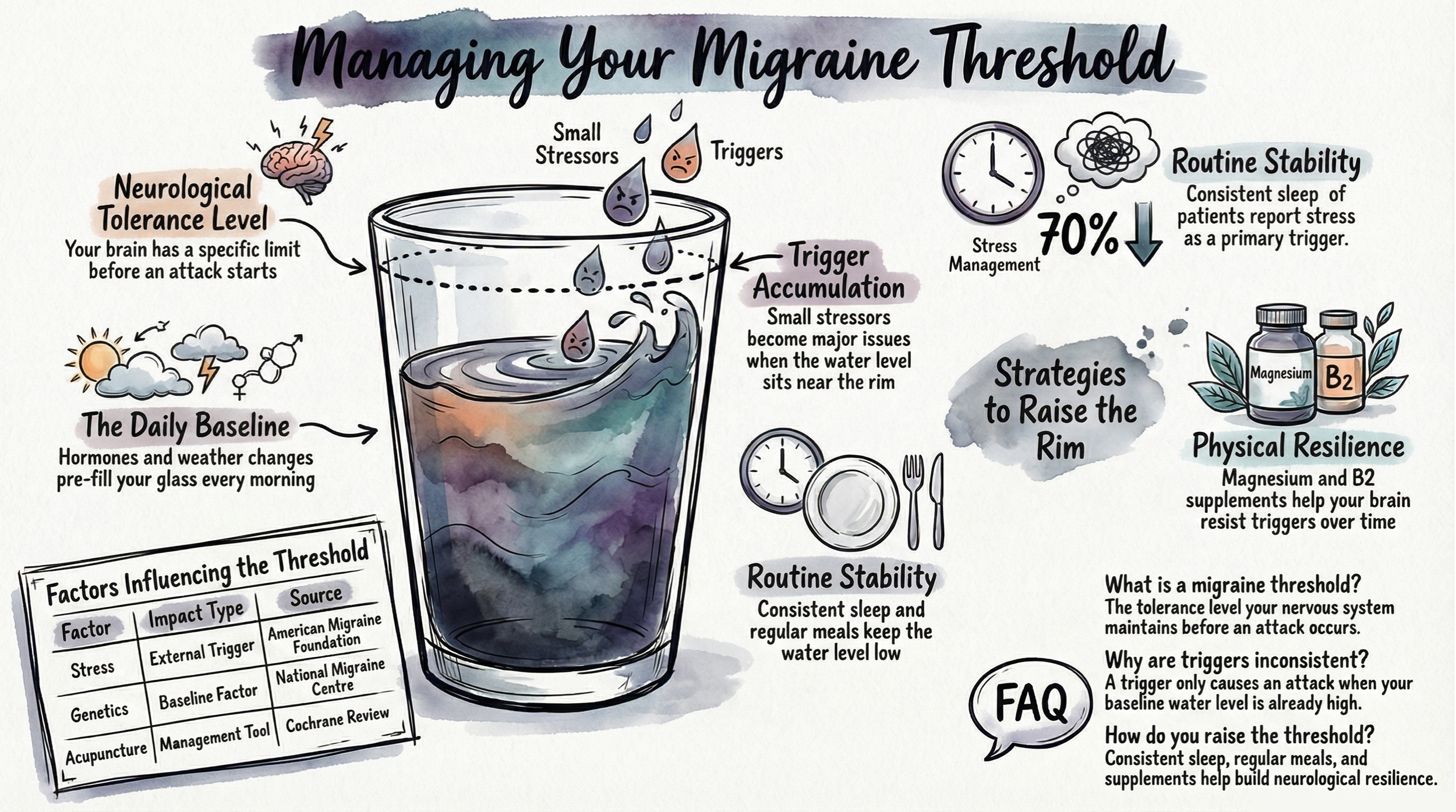
The clearest way I have found to understand migraine threshold theory is with a glass of water.
Imagine your migraine threshold as a glass. When the glass overflows, a migraine occurs. Your job is to keep the water level below the rim for as long as possible.
Here is where most explanations of this analogy stop. But for me, the most important part is the following: you do not wake up each morning with an empty glass.
What pre-fills your glass before the day starts
The water level you wake up with is already set by factors that were in motion before you opened your eyes. Barometric pressure dropping overnight. Where you are in your hormonal cycle. How well you slept, or whether the clock changed last weekend, and your body has not caught up yet. Ragweed season in full effect. Residual muscle tension from an attack earlier in the week. Travel across a time zone.
These are not triggers you chose, and they are not always things you can avoid. They are what sets your baseline for the day. On a high-pressure weather day, or in the first days after your period starts, or during a particularly bad allergy week, your glass wakes up three-quarters full. That changes everything about what happens next.
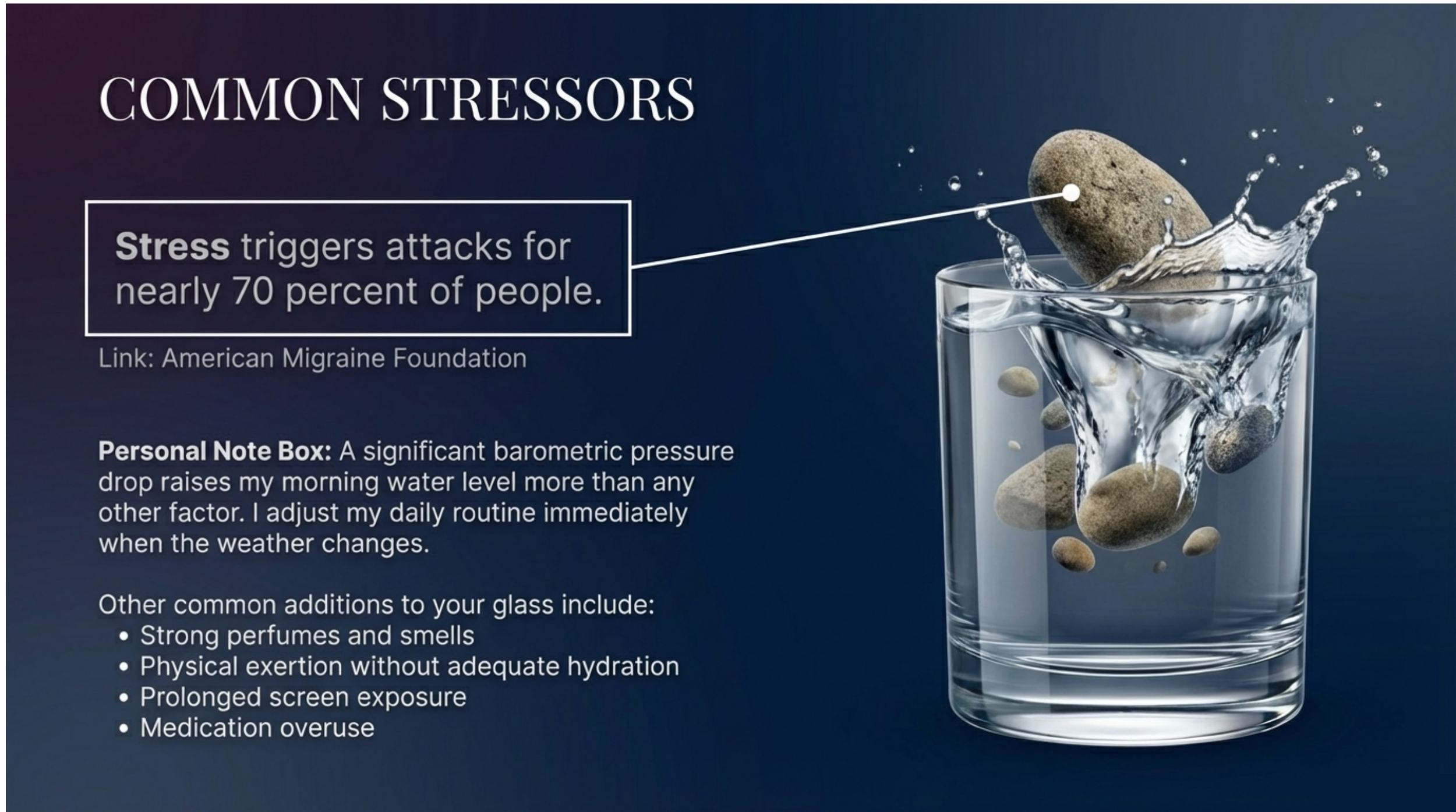
For me, the weather is my biggest pre-fill factor. A significant barometric pressure change can raise my baseline water level more than almost anything else I encounter during the day. I cannot control that. What I can do is be aware of it and adjust everything else accordingly.
Pebbles vs rocks: how triggers behave differently depending on your baseline
Once you understand the pre-fill concept, the inconsistency of migraine triggers starts to make much more sense.
A trigger is not a fixed quantity. The same trigger drops a different amount of water into your glass depending on how full it already is.
On a low-water day, skipping breakfast is a pebble. It registers, but your glass absorbs it, and nothing happens. On a day when the weather has already pre-filled your glass and work has been relentless, skipping breakfast becomes a rock. The glass was already close to the rim, and that one thing tips it.
This is why you can drink the same coffee you always drink, eat the same lunch, sit at the same desk, and have a completely different outcome on two different days.
Here is how I think about my common triggers in pebble versus rock terms:
Stress and work pressure: Usually a pebble. Becomes a rock when it compounds with something else, like a deadline that pushes lunch back three hours and causes my caffeine intake to go up.
Skipping meals or fasting: A pebble on a good day. A rock, any time my glass is already elevated. I now eat something every morning without exception because I know fasting on a high-water day is one of the fastest paths to an attack.
Anxiety and nausea: Anxiety can spike and cause nausea, which then leads to not eating, which raises the water level further.
Sleep disruption: Clocks changing, travel across time zones, or one bad night can significantly raise my baseline for days.
Allergy season: Ragweed in fall is one of my most significant seasonal rocks. During peak season, I treat my whole migraine management differently because I know my baseline is running higher.
Sensory overload: An event with loud music, alcohol, and bright lights, each of those things individually might be a pebble. Together in one evening, they can fill the glass faster than almost anything else.
According to the American Migraine Foundation, stress is a trigger for close to 70% of people with migraines, making it the most commonly reported trigger across the board.
Other commonly reported triggers worth knowing about include strong smells and perfume, physical exertion without adequate hydration, medication overuse (which can actually lower your threshold over time), and poor posture or prolonged screen exposure.
Migraines are a Condition, Not an Episode
This is the part that took me the longest to accept, and the part I most want you to sit with.
You do not catch a migraine. You are not getting over migraines. You are a person with migraines, a neurological condition that is part of how your brain and nervous system are wired.
Research confirms that migraine has a strong genetic component, with the risk being approximately three times higher in close relatives of people with migraines compared to those without.
On your good days, you are below your threshold. On your bad days, you are above it. The condition is present on both days. The acute symptoms are not.
The whiplash comparison helped me understand this clearly. With whiplash, the goal was full recovery. You track progress toward an endpoint. With migraines, there is no endpoint. There is no cure. The goal is management, reducing frequency, reducing severity, learning your patterns, adjusting your habits so that you stay below your threshold more often than not. That is not failure. That is what living with a chronic neurological condition actually looks like.
Accepting this fully changed how I felt about myself on bad days. An attack is not evidence that I did something wrong or failed to manage myself properly. It is my nervous system crossing a threshold, sometimes despite everything I did to prevent it.
The Difference Between a Trigger and a Premonitory Symptom
This is one of the most important and least-discussed distinctions in migraine management, and I’ve found that it helps to remove a significant amount of unnecessary self-blame.
Not everything that seems to precede a migraine is actually causing it.
The prodrome phase, which can begin up to 48 hours before the headache itself, produces symptoms that are easy to mistake for triggers. Cravings for certain foods. Mood changes. Increased yawning. Neck stiffness. Fatigue.

If you reach for chocolate during the prodrome phase and a migraine follows, it is easy to conclude that the chocolate caused the migraine. But the craving for chocolate was already a sign that the migraine was in motion. You did not trigger the attack by eating it. Your brain was already on the way there.
I spent a long time convinced that red wine, aged cheese, and chocolate were triggers for me because I had read that they were common culprits, and I sometimes ate them before an attack. So I ran my own experiment. I tracked carefully what happened after eating each of them, and I went six months without chocolate entirely. The result: no meaningful difference in my migraine frequency, and I was significantly grumpier for having denied myself one of my favourite treats when work stresses me out.
Correlation is not causation. The scientific method applies here just as much as it does anywhere else. Before eliminating foods you love based on a general trigger list, track your actual responses carefully and look for patterns specific to you.
The Migraine Trust covers the distinction between triggers and warning symptoms in more detail.
And Migraine Canada makes an important point that trying to avoid triggers too aggressively can sometimes cause more harm than good by increasing anxiety and hypervigilance, which raises your baseline threshold further.
How Understanding My Threshold Changed How I Manage Good Days
Most threshold theory content seems to focus on what to do when things go wrong. This section, instead, is about what changed on the days when things are going right.
Before I understood the threshold concept, a good day felt like a break from being a migraine person. Now I understand that good days are when management is working, and that has changed my relationship with them entirely.
Practically, it changed my daily habits in ways that feel small but compound over time.

I eat breakfast every morning without exception. Not because I am hungry at 7am, but because I know fasting on a day when my glass is already elevated is one of the first things that turns a pebble into a rock.
I stretch most mornings, focusing on my neck and shoulders. Aiming to reduce the tension that builds there leading up to a migraine. As my muscle pain climbs, it is contributing to my threshold water level, whether I notice it or not.
I pay attention to my body throughout the day in a way I did not before. When I notice jaw tightness or a creeping sensitivity to light, I treat those signals as information. My glass is getting fuller. What do I adjust?
Understanding the threshold did not give me control over my migraines. But it gave me a framework for making better decisions consistently, and over time, that compounds into fewer attacks and shorter recoveries.
How to Raise Your Migraine Threshold Over Time
Raising your threshold means making your nervous system more resilient so that it takes more to tip you into an attack. No single change does this. It is the accumulation of consistent habits over time.
Sleep consistency: Going to bed and waking at the same time, even on weekends, is one of the most well-evidenced ways to reduce migraine frequency. Changes in sleep schedule, including sleeping in, are a commonly reported trigger.
Regular meals: Stable blood sugar reduces one of the most controllable contributors to threshold fluctuation. Eat at consistent times and do not skip meals, particularly breakfast.
Gentle daily movement: Especially stretching for the neck and shoulders. Not intense exercise during an elevated baseline period, but consistent, gentle movement that prevents tension from accumulating.
Stress management: Stress is the most widely reported trigger across all migraine research. Anything that consistently reduces your baseline stress level, whether that is therapy, movement, reduced caffeine, or better work boundaries, contributes to a higher threshold over time.
Preventive supplements: As part of my doctor-recommended regimen, I take vitamin B2, magnesium, CoQ10, vitamin D3, and iron after my period. Research supports B2 and magnesium specifically as preventive tools for reducing migraine frequency over time.
Acupuncture: I use regular acupuncture sessions as a way to release accumulated tenson in my body before it raises my baseline. ACochrane Review found acupuncture to be at least as effective as preventive medication for some migraine patients.
Tracking: You cannot raise your threshold effectively without understanding your personal patterns. A migraine diary, even a simple one, gives you the data to identify what pre-fills your glass most consistently and where your best intervention points are.
On wearable devices: There is growing interest in wearable technology for monitoring physiological signals that correlate with migraine onset, including heart rate variability and skin temperature. This is an emerging area worth watching, though the research is still developing, and I do not personally use one yet.
Progress, Not Perfection
The threshold framework is genuinely useful. It is also possible to turn it into a source of anxiety if you approach it as a system to be gamed perfectly.
You will have attacks despite doing everything right. A dramatic weather event, a hormonal shift, an unavoidable stressful week at work. These things happen, and they can fill your glass faster than your management strategies can compensate for. That is not failure.
The goal is not a perfect record. The goal is to reduce frequency and severity over time and to stop being surprised by attacks that you now have the language to understand.
A migraine is not something that happens to you because you made a mistake. It is your nervous system crossing a threshold. Sometimes you see it coming. Sometimes you do not. The management is about shifting the odds in your favour, consistently, over time.
That shift is worth more than you think. Even one fewer migraine per month can be a massive relief.
FAQ
-
Your migraine threshold is the personal tolerance level your nervous system has before an attack is triggered. It is different for everyone and fluctuates based on internal factors like hormones and sleep, and external ones like weather and stress. When accumulated triggers push past that level, a migraine occurs. Understanding your threshold helps explain why the same trigger does not always produce the same result.
-
Because your threshold was different on those two days. If your glass was already three-quarters full from a weather change, poor sleep, or a hormonal shift, the same trigger that barely registered last week was enough to push you over this week. The trigger did not change. Your baseline did. This is threshold theory in action, and it is one of the most important things to understand about living with migraines.
-
Migraine is a chronic neurological condition with a strong genetic component. For some people, attacks become less frequent with age, particularly after menopause. But migraines do not simply go away. You are always a person with migraines. On good days, you are below your threshold. On bad days, you are above it. The goal of management is to spend more time below the threshold, not to reach a point where the condition no longer exists.
-
The most widely reported triggers across research include stress, hormonal changes (particularly around menstruation), sleep disruption, skipping meals, weather and barometric pressure changes, sensory overload (bright lights, loud sounds, strong smells), and caffeine. Triggers are personal, and the same trigger behaves differently depending on your baseline threshold on any given day.
-
Yes, over time and with consistent effort. Stable sleep, regular meals, daily gentle movement, stress management, preventive supplements (such as magnesium and B2, as recommended by your doctor), and regular acupuncture all contribute to a higher threshold. No single change does it alone. It is the accumulation of consistent habits that shifts your baseline resilience over weeks and months.
-
A trigger is something external that contributes water to your glass. A premonitory symptom is a sign that the migraine is already in motion, appearing in the prodrome phase up to 48 hours before the migraine attack itself. Cravings for certain foods, neck stiffness, mood changes, yawning, and fatigue can all be premonitory symptoms rather than triggers. This distinction matters because it removes the self-blame that comes from thinking you caused your own attack by eating something. If you were already in the prodrome phase, the migraine was already underway.
Ready for More?
If the threshold concept is new to you, then my migraine hangover article and the home relief article are good next reads. Both are grounded in the same framework: understanding what your body is doing and responding to it with intention rather than guesswork.
QUICK ANSWER: A migraine threshold is the personal tolerance level your nervous system has before a migraine attack is triggered. When enough stressors, internal and external, stack up and push past that level, an attack occurs. The threshold is different for everyone and fluctuates day to day. Understanding it helps explain why the same trigger can cause a migraine one week and barely register the next, and why migraines are a condition you manage rather than an illness you recover from.
