10+ Years of Migraines: What I Know Now That I Wish I Knew Then
First off, I want to state that this is not a medical guide.
There are plenty of those, and they have their place. This is the post I wish I could have found in year one when I first started experiencing migraines, written by someone who did not have it figured out then, who made a lot of the same mistakes most people make, and who is still learning now.
If you found your way here because you are trying to make sense of something your body is doing that nobody around you seems to really understand, or because you are ten years into this and still occasionally feel like you are managing it alone, you are in exactly the right place.
It Started Before I Had Words For It
I was in elementary school the first time I remember a migraine stopping me in my tracks.
I did not call it a migraine then. I might have called it a headache, but that term seemed too limiting for the symptoms I was experiencing. I just knew that some days my head hurt in a way that was different from normal, that light felt sharper than it should, that sounds were louder, that I wanted the classroom blinds adjusted, and could not quite bring myself to ask for any adjustments in the classroom.
I was being bullied at the time, and it made me want to disappear rather than draw any attention to myself. I am naturally introverted, and that tendency to stay small was already built into how I moved through the world. Asking a teacher to adjust the blinds because the light was making my head worse felt impossible. Better to just absorb it. Better to just manage.
It took me a long time to understand that the combination of those two things, the migraines and the bullying, compounded each other in a way that shaped how I related to my own condition for years afterward. Being in pain while also trying not to be noticed teaches you to minimise what you are experiencing. It teaches you to question whether you have the right to ask for what you need.
If you recognise that pattern in yourself, I need you to understand something: you do have that right. You always did. An adjustment to the blinds is not a burden. It is a reasonable accommodation for a neurological condition, and you are allowed to ask for it.
The Moment I Realised it was Not Just Headaches
The visual disturbances started to become more frequent and more distinct. Specks at the edges of my vision, the occasional shimmer, a quality to the light that felt off in a way I could not explain.
I went to my optometrist. Perfect vision. So if my eyes were fine, what were the visual disturbances?
This was the era of dial-up internet. If you have never experienced the specific patience required to research your own symptoms on a 56k connection, let me paint the picture: type in a question, wait two minutes for the page to load, read a paragraph, follow a link, wait three more minutes, realise that link was not helpful, go back, wait again. It was not fast. It was not convenient. But it was the internet, and it had answers that the world immediately around me did not.
Somewhere in that slow, patient searching, the word migraine appeared and fit.
I brought what I had learned to my doctor. I got my first medication. And for a while, I think I assumed that the medication meant I had solved it, that I had found the thing that would manage this, and I could move on. Then I noticed I was refilling the prescription almost every month.... So back to the doctor I went, and my doctor put me on daily preventive medication while I was still in high school.
That was the moment it became undeniable. You do not go on daily preventive medication for something you are going to grow out of. This was not a phase. This was not something that would resolve itself if I just waited long enough.
I grieved that a little. I still do sometimes, when a migraine takes something I was excited about. But alongside the grief, there was something else, something that took longer to name. Relief. Finally, having an explanation for why some days were harder than others. Finally understanding that the days where it felt like I was pushing my body through quicks and barely getting through the day were not proof that I was lazy or lacked ambition or not trying hard enough. They were proof that my nervous system was managing a neurological event. That distinction changed things more than I expected it to.
What I Wish Someone Had Told Me in Year One
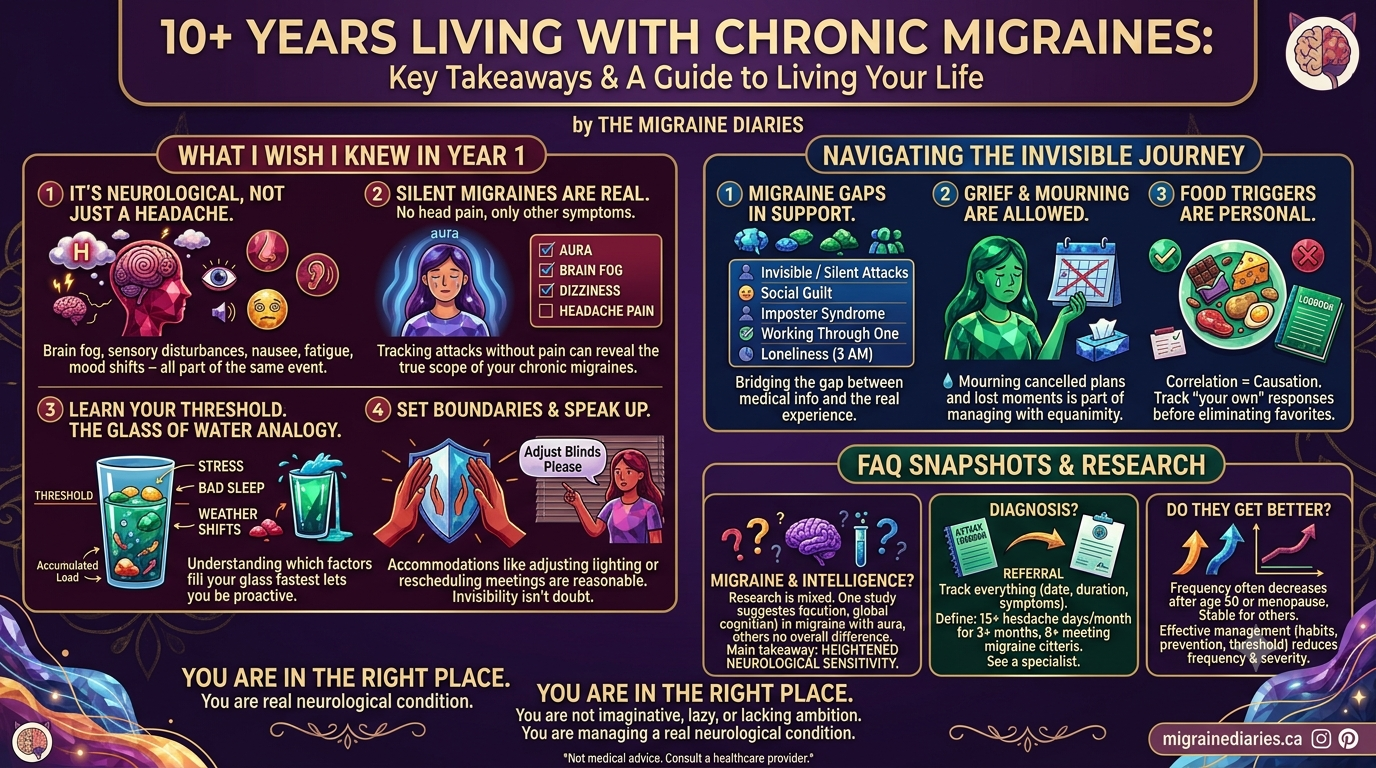
A headache lasting multiple days with vision disturbances is not normal, and you are allowed to ask for help.
Not every migraine looks like the ones described in medical textbooks or shown in dramatic TikTok skits. Some of them are just there, quietly, for days, wearing you down while you try to function normally around them. That is still a migraine. You are still allowed to ask for adjustments. You are still allowed to say something is wrong.
That migraines are neurological, not just pain.
The headache is one component of a much larger neurological event. Brain fog, sensory disturbances, nausea, balance changes, mood shifts, fatigue, and vision changes are all of these are part of the same condition. Understanding that changed how I described my experience to doctors and shifted what I tracked and noticed. The pain is not the whole story. It is not even always the main character.
That you can have a migraine without a headache.
This one took me the longest to understand, and it had the biggest practical impact. I have daily preventive medication that does a good job of reducing the frequency of my migraines with pain. What it does not prevent are the attacks without headache, the ones where the aura, the brain fog, the sensitivity, and the balance changes are all present, but the pain itself is absent or minimal. Once I understood those as migraines too and started tracking them, I more than doubled my recorded migraine count. That shift was what moved me from thinking I had occasional severe migraines to understanding I have chronic migraines and needed to better understand my threshold to manage them. If what I am describing sounds familiar, it is worth speaking with your doctor.
Your migraine threshold is personal, and learning it is one of the most useful things you will ever do.
Every migraine does not have a single cause. It has an accumulated load. I often think of my migraine threshold as a glass of water that fills throughout the day. Some things are pebbles, small additions that barely register. Others are rocks. Some triggers, like weather events, can pre-fill the glass before the day even starts. Understanding which things fill your glass fastest, and what your baseline looks like on any given day, gives you information you can actually act on. It does not prevent every attack, but it changes your relationship with your own body from reactive to proactive.
That correlation is not causation when it comes to food triggers.
When I first started researching migraine prevention, I was devastated to read that red wine, aged cheese, and chocolate were common triggers. These are some of my favourite treats. So I ran my own experiment. I tracked carefully, I gave up chocolate for six months, and I found no meaningful difference in my migraine frequency. What I did find was that I was significantly grumpier after denying myself one of my favorite treats after a stressful day. Food triggers are real for many people. They are also individual. Track your own responses before eliminating things based on a general list.
That setting boundaries is not a weakness.
For a long time, I tried to manage migraines without adjusting anything around me. No asking for the blinds to be changed. No rescheduling meetings. No admitting that something was happening.
What I eventually learned was that the boundaries I set, leaving an event before the sensory overload tips into an attack, turning down a social plan on a high-threshold day, stepping away from a screen when my vision starts shifting, are the things that keep me functional. They are not evidence of how much migraines limit me. They are evidence of how well I have learned to manage them.
That speaking up is harder when nobody can see what is happening, and you have to do it anyway.
Migraines are invisible in a way that makes them easy to doubt, both for the person experiencing them and for people around them. Because there is often nothing to see, the default for many people is to question whether it is real.
Early on, that external doubt became internal doubt. I would wonder whether I was imagining it, whether it was bad enough to warrant being called a migraine, and whether I should just push through. Years later, I understand that the invisibility of the condition is not evidence that it is not real. It means the people around you need more information, and sometimes the only way to get that information across is to say it clearly, even when doing so feels harder than just managing quietly.
That you will mourn things, and that is allowed.
The cancelled plans, the excited commitments you had to back out of, the events you watched from the sidelines because your nervous system had a different idea for the day. That grief is real and does not require an apology. I have found that making peace with the mourning, letting it exist without fighting it or pretending it is fine, is part of managing the condition with any kind of equanimity.
The social guilt is one of the hardest parts.
Being the person who might cancel is a specific, grinding kind of social weight. The internalized identity of being unreliable. The migraine arrives, and the guilt arrives with it, and sometimes the guilt is harder to manage than the migraine.
What helped me was understanding that the guilt is a response to a condition, not evidence of a character flaw. I am not flaky. I am managing something chronic, imperfect, and largely invisible. There is a difference.
That sometimes there is genuinely nothing you can do, and that is ok.
The weather will be the weather. A storm system that sits over your city for three days does not care about your plans. A hormonal cycle follows its own schedule. Some attacks arrive despite everything you did right. Accepting that there are limits to what management can achieve is not giving up. It is being honest about the nature of a neurological condition that does not owe you consistency.
What the Research Says about Migraines and Intelligence (I came across this during one of my migraine research binges)
When I was first researching migraines, I went looking for any upsides. One thing that kept coming up was whether people with migraines are more intelligent. I will be honest: I wanted this to be true.
Unfortunately, the research is mixed. One study from Erasmus University found that people with migraines performed better than controls on tests of executive function, fine motor skills, and global cognition, with migraine with aura showing the strongest results. However, a larger population-based study found no evidence of higher intelligence in people with migraines overall, suggesting that more educated people may simply be more likely to seek medical attention for their migraines, which skewed earlier findings in that direction. This, of course, raises its own concerns regarding how many people are actually suffering from migraines but aren’t officially diagnosed.
So the jury is still out. What the research does consistently show is that migraine is associated with heightened neurological sensitivity, which is not the same as higher intelligence but does point to a nervous system that is processing the world with more intensity than average. Whether that is a benefit depends entirely on the day.
The research also shows, clearly and consistently, that cognitive function is impaired during attacks. Brain fog is not a perception. It is measurable. And longitudinal studies suggest that this impairment does not worsen over time in most people, which is of course a relief.
The Hardest Period: COVID, Job Loss, and Two Kittens Born Under a Deck
In 2020, I lost my job due to COVID restructuring. I was managing anxiety about the pandemic, stress about finding work in one of the most difficult job markets in recent memory, and the particular isolation of that period all at once. My migraines were at their most frequent. My mental health was in a cycle that I could not seem to find a way out of.
Then my parents found two kittens born under their deck.

Lucy and Jerri curled up on a couch.
Lucy and Jerri came into my life at the lowest point of a hard stretch, and I am not sure they know what they did. Lucy, who keeps to herself but shows up as a nurse every time I need one. Jerri, who wants to play and brings me joy on days when I genuinely did not think I had any left. The way they both wait by the door when I come home from work, without fail, without conditions.
Their joy over the smallest things, the way they found each other silly and wonderful and worthy of full attention, broke the cycle I was stuck in. Not because two small cats solved anything structural about my situation. But because they made it impossible to stay entirely in my head, and sometimes that is the intervention you need.
They are part of this blog because they are part of this life. The good days and the bad ones.
Why I Built This
When I started to find migraine content sneaking into my Instagram feed and, of course, my continued research into migraines, I noticed something. Most of it was clinical. Good information, accurate information, medically sourced information. But it was not speaking to the experience of living with chronic migraines in the full, complicated, real-world sense of that phrase.
It was not talking about the silent migraine that nobody in your office can see. It was not talking about the specific loneliness of managing a 3am attack alone with no one to call. It was not talking about the social guilt, or the threshold thinking that finally gave you language for why the same trigger behaves differently on different days, or what it actually feels like to work through a migraine on a day when you cannot stay home. Or even the mental hurdles you have to go through to convince yourself that your migraine is “enough” to be considered one, the impostor syndrome is as real here as it is in the workplace.
And it was almost never talking about managing this without a support system at home. Without a partner who has learned your warning signs. Without someone to turn off the television or bring you water or just be there.
That gap is what this site is for.
I am not a doctor. I am not a neurologist. I am someone who has had chronic migraines for over a decade, who has managed most of it alone, who got a lot of it wrong before I started getting it right, and who has no interest in pretending any of it is simpler than it is.
You Are in the Right Place
Whatever brought you here, a new diagnosis, trying to make sense of what is happening, years of migraines, and the feeling that nobody has quite described your experience accurately, the need to find something honest in a space full of clinical summaries and medication lists, this is the place.
You are not imagining it. You are not being dramatic. You are not lazy or lacking in ambition on the hard days. You are managing a neurological condition, imperfectly, like the rest of us.
The community here is built for people in the gap between the medical information and the real experience of living with migraines. Come in.
FAQ
-
Start tracking your attacks, including the ones without significant head pain, before you see a doctor. Note the date, duration, symptoms, location of pain or pressure, any visual disturbances, how you managed it, and how long recovery took. That log gives your doctor far more to work with than a general description. Chronic migraine is defined as 15 or more headache days per month for more than three months, with at least eight of those meeting migraine criteria, according to the International Headache Society. If your frequency is approaching that, raise it directly with your GP and ask for a referral to a neurologist.
-
The research on this is still developing. Current evidence suggests that chronic migraine is associated with a higher risk of anxiety and depression, reduced quality of life and work productivity, and in some cases small changes in brain structure on imaging, though the clinical significance of those changes is debated. Longitudinal cognitive studies do not suggest progressive cognitive decline over time in most migraine patients.
The most significant long-term effects are on daily functioning, relationships, and mental health, which is part of why honest, practical resources about living with the condition matter alongside the clinical information.
-
For some people, yes. Migraine frequency often decreases after age 50, and some people experience a significant reduction after menopause. For others, the pattern remains relatively stable with management. Preventive treatment, consistent lifestyle habits, and understanding your personal threshold all contribute to reducing frequency and severity over time, but the condition itself does not simply resolve. Managing it well is a long game, and the progress is real, even when it is incremental.
-
The glass of water analogy works well for explaining why the same trigger does not always produce the same result. For the broader reality of the condition, I often say: imagine that on some days your nervous system is running at full sensitivity, every sensory input costs more to process, your cognitive bandwidth is reduced, and there is nothing wrong with you that rest, food, and willpower can fix, because it is neurological. The condition is always present. The acute symptoms come and go. On good days, the management is working. On bad days, it is not.
-
The short answer is that the research does not support it clearly. One Erasmus University study found better performance on executive function and global cognition tests in migraine sufferers, particularly those with aura. But larger population-based studies found no significant intelligence difference overall, noting instead that more educated people tend to seek medical diagnosis more often, which may have skewed earlier findings. What is consistently supported is that migraine involves a nervous system with heightened sensitivity to environmental input. Whether that is an advantage depends on the day and the circumstances.
Ready for More?
This blog covers the full reality of living with chronic migraines, from understanding your threshold and managing attacks at home to the working migraine experience and what recovery actually looks like. Start wherever feels most relevant to where you are right now.
QUICK ANSWER: Living with chronic migraines is a unique and often isolating experience. Over the past decade, I've learned that migraines are much more than just headaches; they are complex neurological events that can affect every part of your life, from your senses and mood to your energy and social connections. Many of the hardest parts are invisible: the doubt, the guilt, the grief for lost moments, and the challenge of setting boundaries. What I wish I knew earlier is that you are allowed to ask for help, that not every migraine follows the textbook, and that tracking your symptoms can empower better conversations with your doctor. Managing chronic migraines isn’t about perfection; it’s about learning your own patterns, finding what helps, and giving yourself permission to advocate for your needs.
