Is It Normal to Lose Days to Migraines? What Nobody Tells You
There is a moment that always seems to happen when a migraine finally lifts. You check your phone. You look at the window to see how much light is left. And you do the calculation of how much of the day, or the week, has been lost to this migraine.
Nobody really seems to talk about that moment and the feelings it stirs up. The clinical articles cover duration, phases, and treatment windows. What they don’t seem to cover is what it feels like to keep living with a condition that takes days from you on a regular basis, and what to do with that.
What Is a Migraine Attack, Actually?
Before we go further, let’s make sure we’re on the same page about what migraine is. Migraine is a neurological disease, not a bad headache. According to the American Migraine Foundation, a migraine attack involves debilitating head pain that interferes with your ability to function, alongside symptoms including nausea, vomiting, and sensitivity to light, sound, and smell. The experience varies significantly from person to person and from attack to attack.
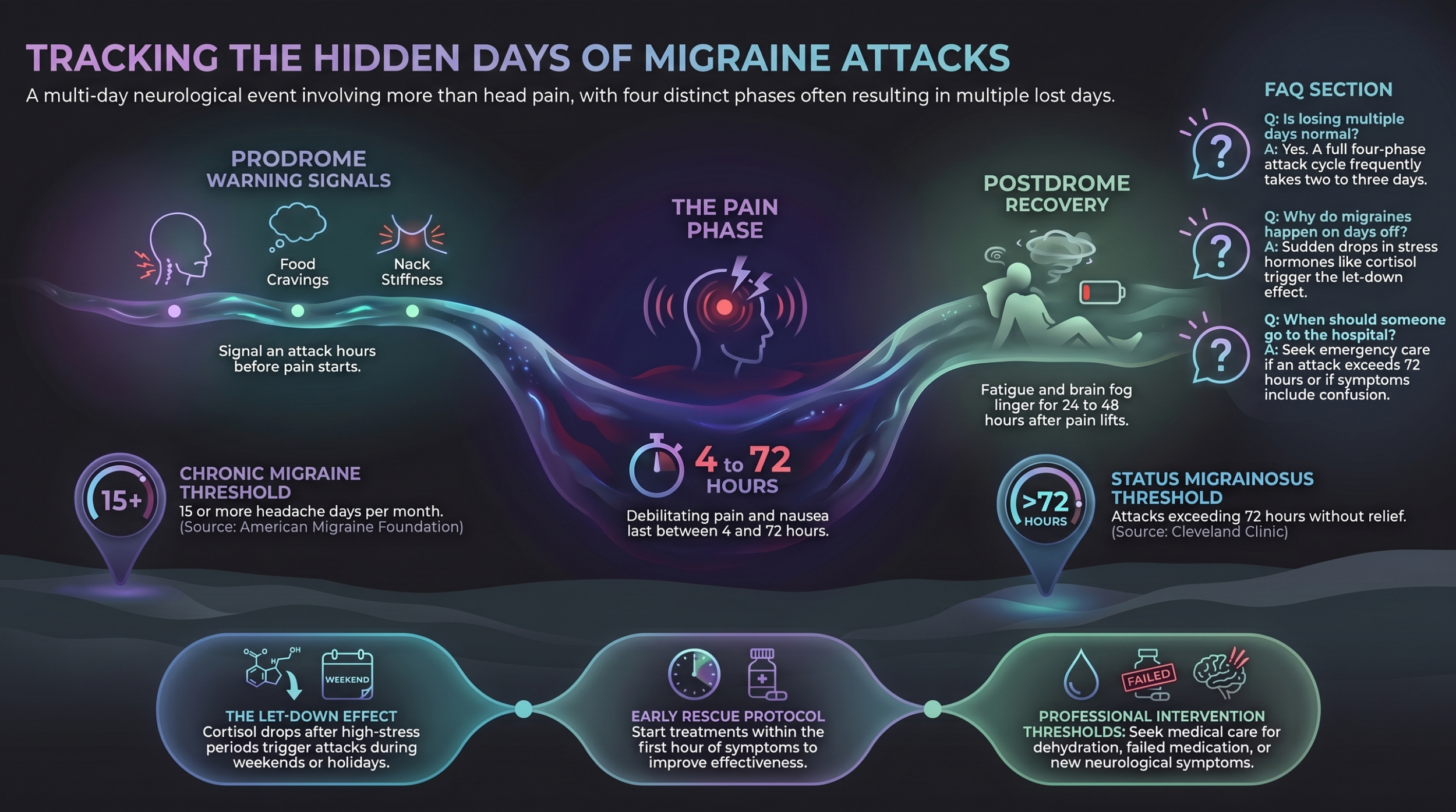
A full migraine attack moves through up to four phases:
Prodrome: the hours before the pain, where your body sends warning signals. Jaw tension, food cravings, yawning, mood shifts, neck stiffness. Many people miss this phase for years.
Aura: visual or sensory disturbances that occur in some but not all attacks. Flickering lights, blind spots, tingling. Usually resolves within an hour.
Headache: the phase most people associate with migraine. Can last 4 to 72 hours.
Postdrome: the recovery phase after the headache lifts. Brain fog, fatigue, emotional flatness, and physical exhaustion that can last another 24 to 48 hours.
Not everyone experiences every phase in every attack. But the key point is this: the headache is not the whole attack. By the time you account for the prodrome that cost you your morning and the postdrome that flattened the day after, a single migraine can take two to three days from your life, even when the pain phase itself was relatively short.
For a detailed breakdown of what postdrome actually feels like and how to recover from it, the migraine hangover post covers that in full.
And for people who experience silent migraines, attacks with no head pain at all but all of the neurological disruption, the time loss is just as real and significantly harder to name. For years, I tracked those days as "off days" without understanding what they were. That changed everything about how I counted my migraine days.
So, Is It Normal to Lose Days to Migraines?
Yes. More than most people realize, and it takes more time than most people admit.
The American Migraine Foundation defines chronic migraine as 15 or more headache days per month for a period of three months or longer. At that frequency, you are losing roughly half of every month to some form of migraine impact. That is, before you factor in the postdrome days, the prodrome days, the working migraines, where you technically function, but everything costs twice as much.
I have known for a long time that the number of days I have lost to this condition is large. I know it without doing any calculation, the way you know a room is full without counting every person in it. I have chosen, deliberately, not to total it up. Not because I am avoiding reality, but because I know that knowing that number wouldn’t help me, but it might break something in me and make me focus on how living with migraine has impacted my past rather than focusing on how to live with this condition in the future.
What helps is focusing on what I can do today to protect tomorrow. What I can eat, how I can sleep, what I can manage around the edges. The number exists. I do not need to stare directly at it to know it is there.
If you have made the same choice, that is not denial. It is a survival strategy that a lot of people with chronic conditions quietly adopt, and it deserves to be named as such.
The Grief Nobody Warned You About
Losing days to migraines is not one feeling. It is several, and they rotate depending on the day and the context.
Sometimes it is frustration. Pure, sharp, unreasonable-feeling frustration at a body that will not cooperate with the life you are trying to build.
Sometimes it is fear. The kind of fear that arrives when a big event is coming up on the calendar and you feel the prodrome starting two days before. A wedding. A work presentation. A concert you bought tickets for six months ago. The migraine does not know or care about your plans, and the anticipatory dread of losing that day is its own kind of suffering layered on top of the physical one.
Sometimes it is numbness. After enough years of this, there are attacks where you do not feel much at all. You go through the protocol. You lie down. You wait. The emotion has been worn smooth by repetition.
And sometimes it is exhaustion. Not tiredness. A deeper kind of worn-down that comes from managing something relentless for a very long time, alone, without a clear endpoint.
All of these are appropriate responses to a real loss. They do not need to be fixed or reframed. They need to be named.
The 48-Hour Wall
I have not crossed the 72-hour clinical threshold for status migrainosus, but I have been close enough to understand why it is classified separately from a regular attack.
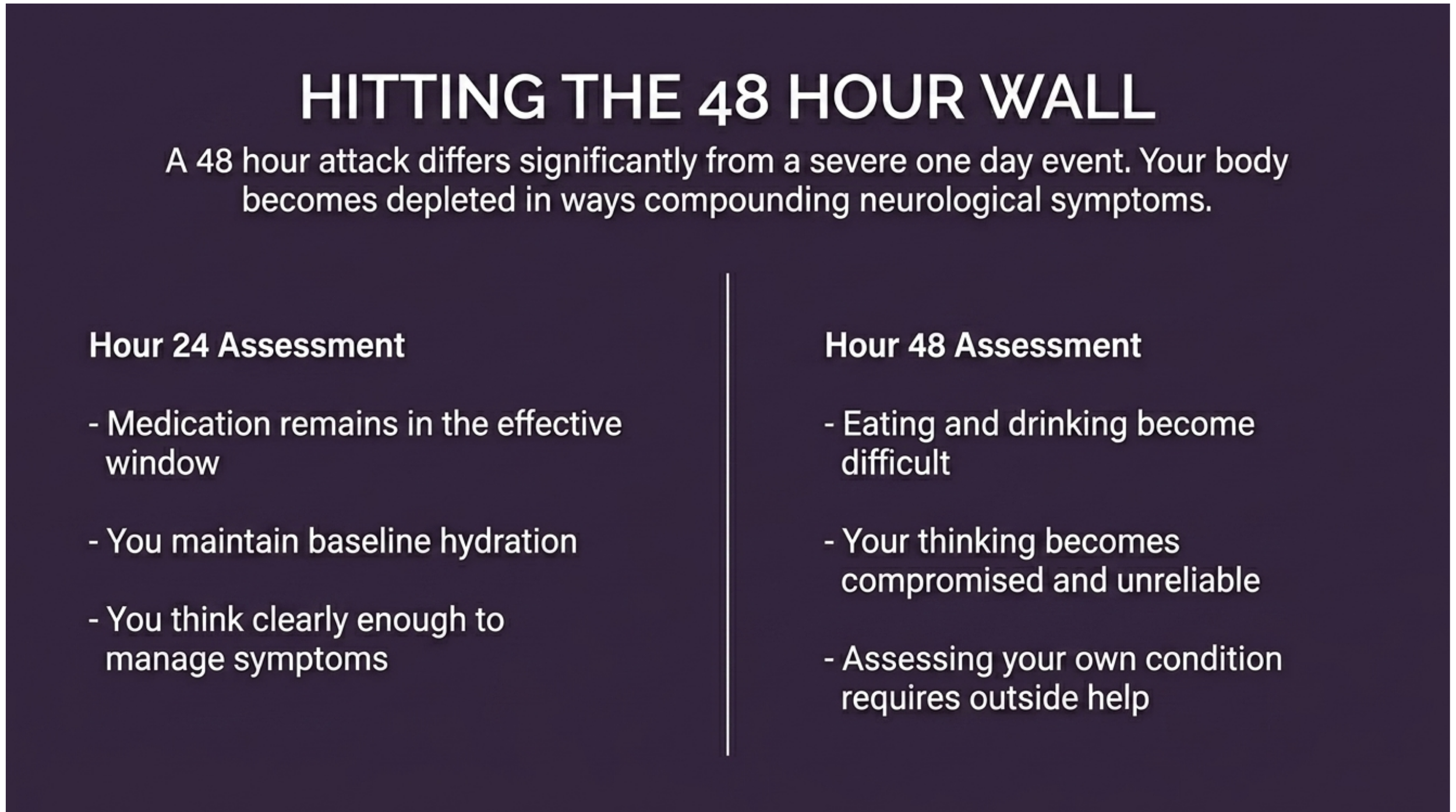
A 48-hour migraine is a different experience from a severe one-day attack. By hour 24, your body is depleted in ways that compound the neurological symptoms. Eating is difficult. Drinking enough is difficult. The medication you took in the first hours is long past its window. Your thinking is compromised, not slightly foggy but genuinely unreliable, at exactly the point when you might need to make a decision about whether to call for help.
That last part is something I do not hear talked about often enough: the vulnerability of being mentally compromised at the moment you need to assess your own condition clearly. Managing this alone means there is no one in the room to make that call with you. I have thought about whether I would be able to reach for my phone and dial at hour 40 or 48. I am not certain I would.
What I have is a support network that knows how to check on me. Someone who would notice the silence and come.
If you are in a similar position, it is worth having that conversation with someone before you need to rely on it. Not as a plan for a crisis, but as a quiet agreement between people who care about each other.
Why Migraines Happen on Days Off: The Let-Down Effect
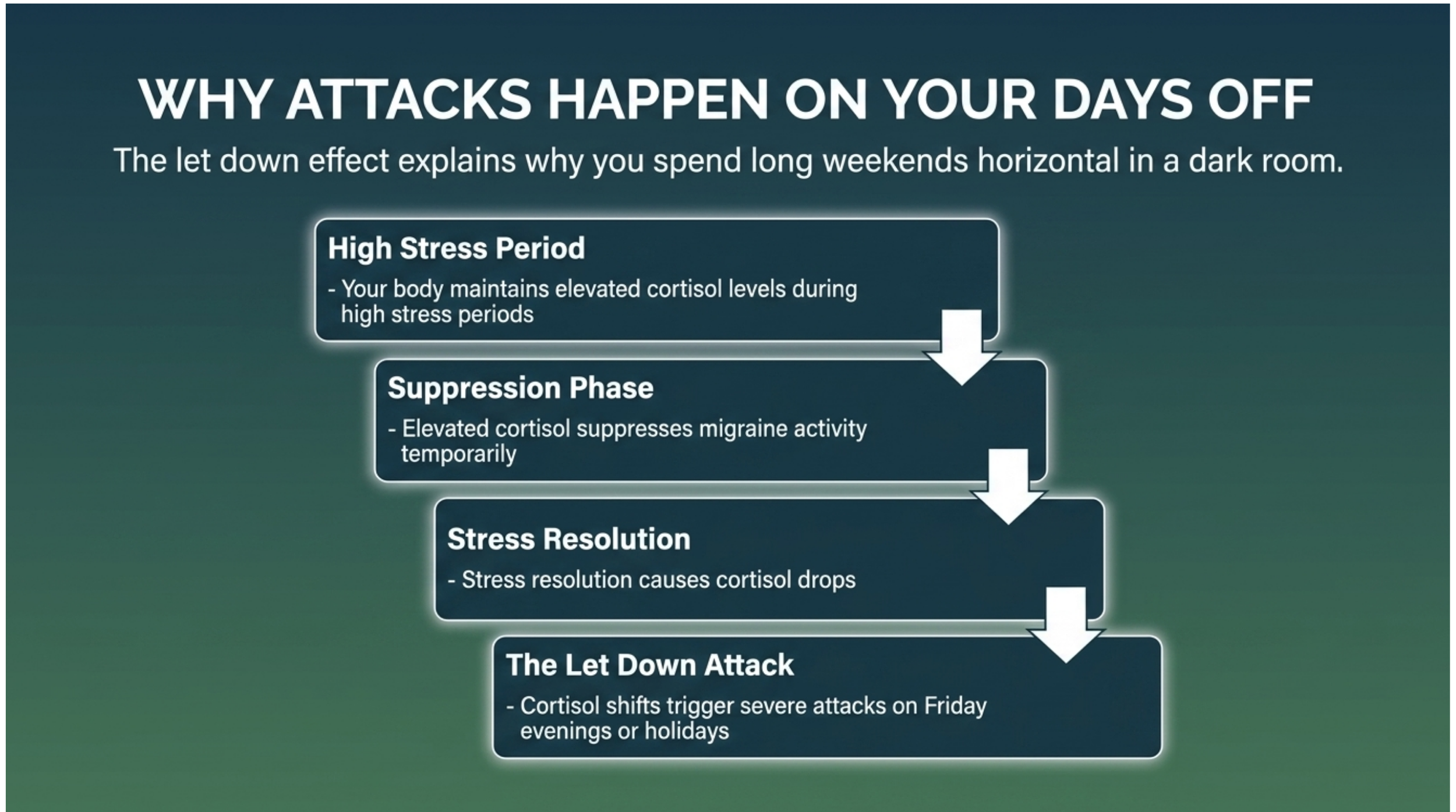
If you have ever made it to a long weekend or the first day of a holiday and then spent it horizontal with a migraine, you have met the let-down effect.
The mechanism is real. During high-stress periods, your body maintains elevated cortisol levels, which can actually suppress migraine activity temporarily. When the stress lifts, cortisol drops, and that shift can trigger an attack. The migraine your body was holding at bay all week arrives on Friday evening, or Saturday morning, or the first day of a trip you planned for months.
The cruelty of this is particularly strong for people with chronic migraine. When your good days are already limited, losing one to a let-down attack after a hard week is a loss that compounds. The stress caused the suppression. The relief from the stress caused the attack. There is no real winner in that equation.
When a Migraine Will Not End: Status Migrainosus
A migraine that crosses the 72-hour mark without a pain-free window is classified as status migrainosus. According to the Cleveland Clinic, this is a medical condition that requires different treatment from a standard attack and often needs professional intervention.
If you are approaching or past the 72-hour mark, this is when to seek support:
When you cannot keep fluids down and are at risk of dehydration
When your rescue medication has failed or you have used it beyond the recommended dose
When the pain is significantly more severe than your typical attacks
When you experience any symptoms that are new or different, including sudden severe onset, fever, vision changes, weakness, difficulty speaking, or confusion
Emergency treatment for status migrainosus typically involves intravenous fluids, anti-nausea medication, and specific migraine treatments administered in a clinical setting. Your neurologist should have a plan in place for this scenario. If you have not had that conversation yet, it is worth initiating.
The practical reality of managing alone during a prolonged attack is that your capacity to make decisions decreases as the attack continues. Have a plan before you need one. Know what the threshold is for calling someone. Know what number you will dial if you reach it.
How to Keep Going When Days Keep Disappearing
The answer that nobody wants to hear is that there is no version of this that stops being hard. What changes is how you carry it.
Focusing on the day in front of you rather than the accumulated weight of the ones behind you is not a platitude. It is a practical decision made every morning. You choose where to put your attention because the alternative, tallying everything the condition has cost you, does not make tomorrow easier. It makes it harder.
On the good days, the instinct is to overfill them. To compensate for what was lost by doing more than you should. The better instinct, and the harder one, is to protect those days. To use them well without depleting them. To let something be easy.
Lucy and Jerri are a big part of how I do that. Not because cats are a cure for anything, but because they ask nothing of me on the bad days and offer something warm and consistent on the good ones. Sometimes that is enough to shift the weight of a day just slightly. Jerri on the end of the bed. Lucy appearing when she decides I need her. Small, reliable, not requiring anything in return.
Find your version of that. Whatever asks nothing of you and gives something back anyway.
What Actually Helps on the Days You Lose
On the day itself:
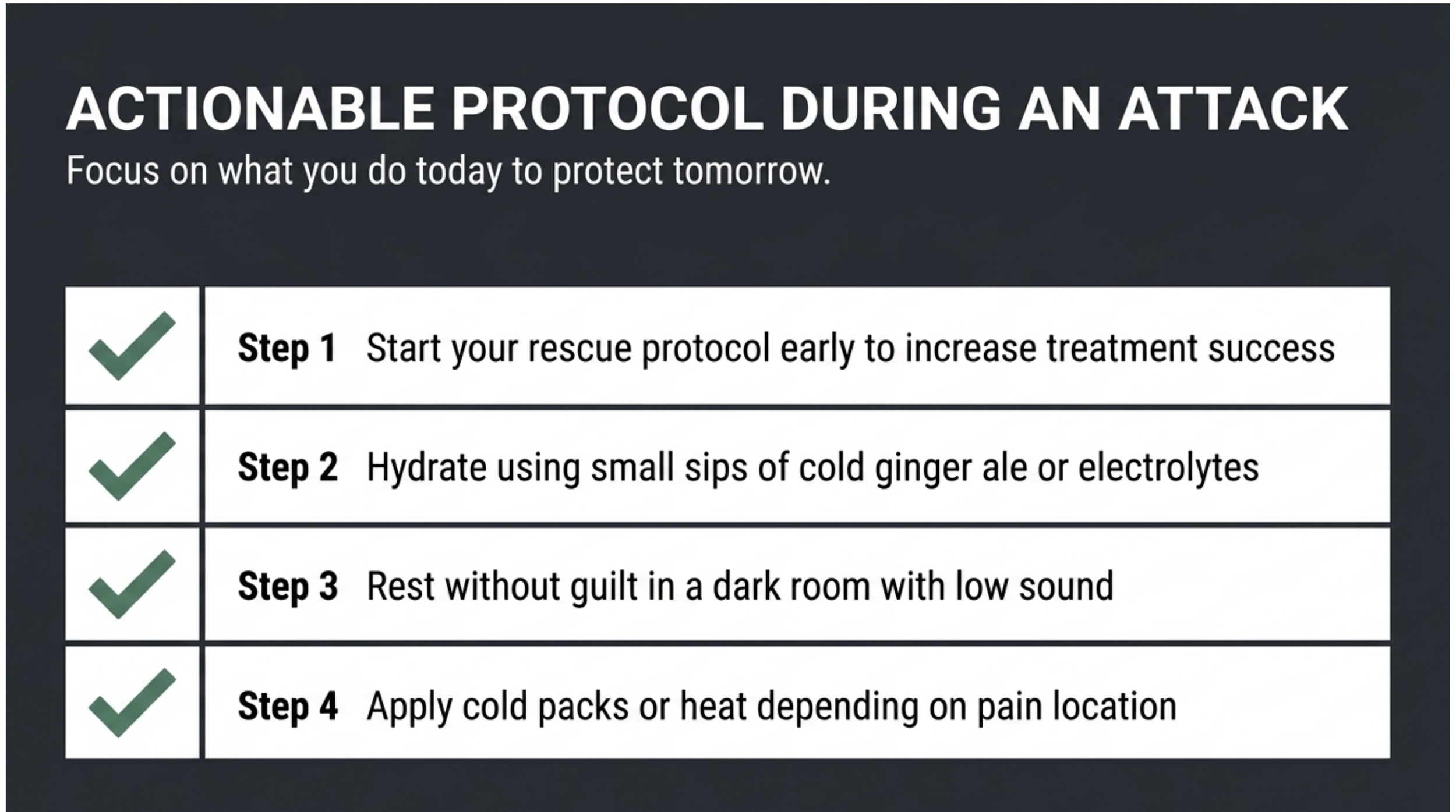
Start your rescue protocol early. The window matters. The earlier you act in the attack, the more likely the treatment is to work.
Hydrate in whatever form you can manage. If nausea makes drinking difficult, small sips through a straw, cold ginger ale, water with electrolytes, whatever stays down.
Rest without guilt. The day is already changed. Fighting it costs more than accepting it.
Dark room, low sound, cold pack or heat depending on where the migraine is sitting.
On the emotional side:
Name what you are feeling without building a case around it. Frustrated today is not the same as this is always going to be this bad.
The postdrome is still the migraine. The fog, the flatness, the exhaustion the day after are not laziness. They are part of the attack. Rest accordingly.
Grieve the day if you need to. Then begin again tomorrow.
The migraine hangover post has a full recovery plan for the postdrome phase, including what to eat, how to move gently, and how to manage the relapse risk that comes from returning to normal activity too quickly.
You Are Not the Only One Doing This Calculation
The moment when the migraine lifts and you check what time it is, what day it is, how much is left. Everyone who lives with this condition knows that moment. But most of us have never really heard or had to describe it out loud.
Losing days to migraines is normal in the sense that it is common. It is not normal in the sense that you should have to accept it silently, or pretend the grief is not there, or perform gratitude for the days that remain while quietly mourning the ones that did not.
You are allowed to feel the weight of this. The frustration, the fear, the numbness, the exhaustion. All of it.
And then, when you are ready, you take the next day. You do what you can with it. You protect it where you are able. You notice the small things that ask nothing of you and give something back anyway.
It’s not a cure. It is not even a particularly tidy answer. But it is what actually works over the long run, and it is the most honest thing I can tell you. It’s also the best path forward I’ve been able to find where you don’t end up losing more time by fixating on how much time living with migraine has taken.
If you are working on understanding your own migraine pattern, including how long your attacks run, what your prodrome signals look like, and how to track the days that are costing you the most, my Migraine Survival Kit has a trigger tracker and prodrome checklist built for exactly that. Download it here.
FAQs
-
Yes. A single migraine attack can last from 4 hours to several days when all four phases are included. For people with chronic migraine, defined as 15 or more migraine days per month, losing multiple days to attacks every month is a common and underreported reality. The fact that it is not widely discussed does not make it less valid.
-
According to the American Migraine Foundation, the headache phase of a migraine attack lasts between 4 and 72 hours. When you include prodrome and postdrome, the full attack experience can extend up to a week in some cases, though this is not typical. Most attacks affect people for one to two days in total.
-
They can. Prodrome symptoms begin hours before head pain arrives, and postdrome symptoms continue for 24 to 48 hours after it lifts. Some people also experience migraine cycles where one attack is followed closely by another, creating the sensation of a migraine that comes and goes across several days.
-
This is the let-down effect. During stressful periods, elevated cortisol levels suppress migraine activity. When the stress resolves, the cortisol drop can trigger an attack. This is why migraines so often arrive on Friday evenings, the first day of a holiday, or the morning after a high-pressure deadline. The stress-induced migraines post covers this pattern in full.
-
Status migrainosus is a migraine attack lasting more than 72 hours without a pain-free interval. According to the Cleveland Clinic, it requires different treatment from a standard attack and often needs medical intervention. Go to emergency care if your migraine has passed 72 hours, if you cannot keep fluids down, if your usual medication has failed, or if you experience any symptoms that are new or more severe than usual, including sudden onset, fever, weakness, or confusion.
-
Some attacks resolve within a few hours, particularly if treatment is taken early in the prodrome or headache phase. Others persist regardless of treatment. The duration varies significantly between individuals and between attacks in the same person. Treating early, within the first hour of symptoms, gives you the best chance of shortening the attack.
-
There is no single answer that works for everyone. What helps many people is choosing deliberately not to total the accumulated loss, focusing instead on what is within reach today. Naming the feelings without building a narrative around them. Finding something small and consistent that asks nothing of you. And recognizing that the grief is a reasonable response to a real loss, not something to be fixed or optimized away.
The content on this page is based on personal experience and is not medical advice. Always consult your doctor regarding your migraine management and treatment plan.
QUICK ANSWER: A migraine attack can last anywhere from 4 hours to 3 days in the headache phase alone. When you include all four phases, including the prodrome before the pain and the postdrome after it, a single attack can affect you for up to a week. For people with chronic migraine, defined as 15 or more migraine days per month, the days add up into something most of us stop wanting to count. Losing days to migraines is not unusual.
