Migraine Burnout Is Real and It Is Different From Regular Burnout
There is a version of exhaustion that comes from working too hard for too long. Most people have been there. You know what caused it, you can identify what needs to change, and there is usually a path out that involves rest, boundaries, or a shift in workload.
Migraine burnout is different. It is the exhaustion that comes from managing a condition that never fully resolves, that demands constant monitoring, that costs money and time and energy and relationships, and that keeps arriving regardless of how carefully you manage it. The cause is not something you can change. The path out is not as clear. And it does not stay contained to one area of your life. It moves through everything.
If you have reached the point where managing your migraines feels like more than you can sustain, this post is about what that actually is, why it happens, and what recovery looks like when the thing you are burned out on is a condition you cannot leave behind.
What Regular Burnout Feels Like
The Cleveland Clinic defines burnout as a state of emotional, physical, and mental exhaustion caused by prolonged or excessive stress. It tends to develop when demands consistently exceed your capacity to meet them, and it is most commonly associated with work, though it can develop in caregiving, relationships, or any sustained high-demand role.
Regular burnout is difficult. It is also, in most cases, contained. It has a clearer origin and a more identifiable path out. Remove or reduce the source of the demand, and rest, reset, and recovery become possible. The domain it affects is usually identifiable and somewhat separable from the rest of your life.
That containment is what makes migraine burnout different.
What Migraine Burnout Feels Like
Regular burnout is contained to an aspect of life. Migraine burnout impacts everything at once.
When migraine burnout hits, it is not just the migraines that feel like too much. It is the tracking, the appointments, the explaining, the financial drain, the canceled plans, the guilt, the hypervigilance, the treatments that work until they do not, and the particular weight of knowing this is not going to resolve. Every domain of your life is touched by the condition, which means when you burn out on managing it, the exhaustion spreads across all of them simultaneously.
The feeling is having nothing left to give, and it still not being enough. Emotions that feel dulled and flat, alongside an urge to cry that does not always come with a clear reason. The exhaustion of not knowing how to stop, and no clear picture of what doing things differently would even look like.
It is both physically exhausting and mentally terrifying to be in that place. The usual tools feel inaccessible. The usual strategies feel pointless. And the condition itself keeps arriving, indifferent to any of it.
What Causes Migraine Burnout
Migraine burnout rarely comes from a single source. It accumulates.
The Time Cost
Managing chronic migraine is a part-time job that does not pay. Neurologist appointments, GP follow-ups, acupuncture sessions, prescription management, supplement schedules, tracking logs, trigger analysis, and the ongoing adjustment of every variable in your life that might be contributing. This runs in the background of every day, on top of everything else you are already managing.
The Financial Cost
Preventive medications, rescue medications, supplements, specialist appointments, and the income impact of missed work days add up over years in a way that is hard to fully account for. Managing this condition alone on a single income, without a partner to share the financial load, makes the cost more visible and more pressing. The financial strain is its own stressor, which is its own migraine trigger, which adds to the financial strain.
The Emotional Cost of Explaining Yourself
Repeatedly justifying an invisible condition to employers, colleagues, friends, and family requires energy that compounds over time. The effort of being believed, of finding the right language, of managing other people's skepticism while also managing your own symptoms, is a sustained emotional load that rarely gets acknowledged as part of what managing migraines actually costs. For the version of this that plays out at work, the migraine absences post covers that conversation in more detail.
The Hypervigilance Trap
This is the one that does not get talked about enough.
When you manage a condition at high frequency, monitoring becomes survival. You track your sleep, your meals, your stress levels, your weather app, your cycle, your screen time, and every symptom that arrives, looking for the pattern that will give you more control. You micro-analyze every variable. You do everything the research recommends. You build systems and routines and contingency plans.
And then you still get the migraine.
The monitoring itself becomes exhausting. Not because it is not useful, it often is, but because it never turns off. Hypervigilance stops being a tool you pick up and put down. It becomes the baseline state of your nervous system. You are always watching, always assessing, always half-braced for what is coming next.
Stepping back from that is genuinely difficult, because by the time you recognize it has become too much, the hypervigilance is already woven into how you move through every day. The idea of stopping feels both necessary and frightening.
Treatment Fatigue
There is a specific kind of defeat that comes from a treatment that helped for a while and then stopped. Or from trying something new with cautious hope and finding it does not work either. Or from doing everything correctly according to your management plan and still experiencing the same frequency you were before. Treatment fatigue is real, it is common, and it compounds every other source of burnout because it removes the sense that effort produces results.
The grief of what the condition has taken
Plans that were canceled and not rescheduled. Events missed. Opportunities that required consistency, the condition did not allow. Relationships that were strained by repeated absence. The version of your life that might have existed without this as a constant variable. This grief does not require dramatizing. It is simply the honest accounting of what chronic illness costs over a decade or more.
Cephalalgiaphobia: The Anxiety of the Next Attack
Cephalalgiaphobia refers to the fear and anxiety cycle that develops around anticipating the next migraine attack. It is a recognized feature of chronic migraine, and it is exactly as exhausting as it sounds.
Even on the good days, the next migraine is never fully out of mind. Before a big event at work, before a social occasion you have been looking forward to, before travel or a deadline or anything that requires you to show up reliably, the background question is always there: is this the day one comes?
That low-level dread is hard to shake in good days. It creates a kind of provisional living, where you are present but also half-monitoring, enjoying something while also cataloging whether you are hydrated enough, whether the light is too bright, whether the tension in your neck is the beginning of something.
The approach that helps most is redirecting that anxiety toward what is actually within your control. Drinking more water. Eating a magnesium-focused meal. Keeping the sleep schedule consistent. Taking the supplement at the right time. Converting the dread into action does not eliminate the anxiety, but it gives it somewhere useful to go rather than letting it sit and compound. The migraine threshold post covers the trigger management framework that makes this redirection practical rather than just theoretical.
When Migraine Burnout and Work Burnout Hit at Once
During the COVID period, when a job loss compounded an already difficult migraine pattern, both arrived simultaneously. The work burnout removed the sense of control and stability that employment had provided. The migraine burnout was already present underneath it. Together, the combination left no domain that felt manageable.
What made that combination uniquely destabilizing was the way the two fed each other. Work burnout often drives people toward the areas of their life where effort feels like it produces results. For someone managing a chronic condition, migraine management can become that domain, the one place where you feel like you are doing something. But when migraine burnout is also present, that anchor disappears too. There is nothing left that feels within your control, and the exhaustion of that is both physical and deeply disorienting.
It was during that period that Lucy and Jerri came into the picture, born under my parents' deck during COVID and arriving at exactly the low point where something needed to shift. They did not fix anything. They did not need to. They just broke the cycle of being alone in it, in the way that only something that requires nothing from you and offers warmth without condition can. The full story of that period is in my 10 years of migraines post.
The Impact of Burnout on Mental Health
Burnout and mental health do not operate independently. Sustained burnout, particularly the kind that comes from chronic illness, is associated with increased risk of depression and anxiety. The relationship between chronic migraine and depression is bidirectional: each condition can worsen the other, and burnout accelerates that cycle by depleting the resources needed to manage both.
The emotional flattening that comes with burnout, the dulled affect, the loss of motivation, the sense that nothing is worth the effort, can be difficult to distinguish from depression, and in some cases, it develops into it. If what you are experiencing feels like more than exhaustion, if it has persisted for several weeks and is affecting your ability to function across multiple areas of your life, speaking with your GP or a mental health professional is worth doing. Burnout is not a character flaw, and neither is needing support to get through it.
How to Actually Recover From Migraine Burnout
Recovery from migraine burnout does not look like optimizing your management plan. It looks like temporarily stepping back from it.
Hiding the Tracking Tools
This is a deliberate decision to put the tracking away for a period is one of the harder things to do when hypervigilance has become the default. The tracking feels protective. Stopping it feels like losing control of the one thing you could influence.
It is sometimes necessary anyway. When the monitoring itself has become a source of exhaustion rather than a source of information, putting it away, physically out of sight, is a way of interrupting the loop. Not permanently. Just long enough to remember what it feels like to move through a day without cataloging it.
Carving Out Time that Belongs Entirely to You
The activities that help most during migraine burnout share one quality: they are disconnected from the internet and therefore from the pull toward researching solutions, tracking symptoms, or reading about what else you should be trying.
Some examples of what has worked for me include:
Rewatching a favourite show.
Reading a book that has nothing to do with health or productivity.
Gardening.
Baking sourdough and experimenting with a new recipe.
You want something that is just yours, that asks nothing of you in relation to the condition, and that you were doing before migraine management became a significant portion of your cognitive load.
These activities are not distractions from the burnout. They are the reset. They are what remind you that you exist outside of the condition, and that that version of you is still there and still worth protecting.
Giving Yourself Permission to Just Exist
This permission part is one of the hardest part of recovery, and it is not a one-time decision. It is something you have to keep choosing, against the internal voice that says you should be doing something useful, that resting is falling behind, that the condition will get worse if you stop watching it so carefully.
Just because you can monitor and manage and push through does not mean you have to do it right now. The self-permission language from the push through or rest post applies here too: resting now protects more capacity than it costs. Giving yourself permission to stop managing for a period is not giving up. It is giving yourself something to come back from.
Lucy, Jerri, and Low-Demand Days
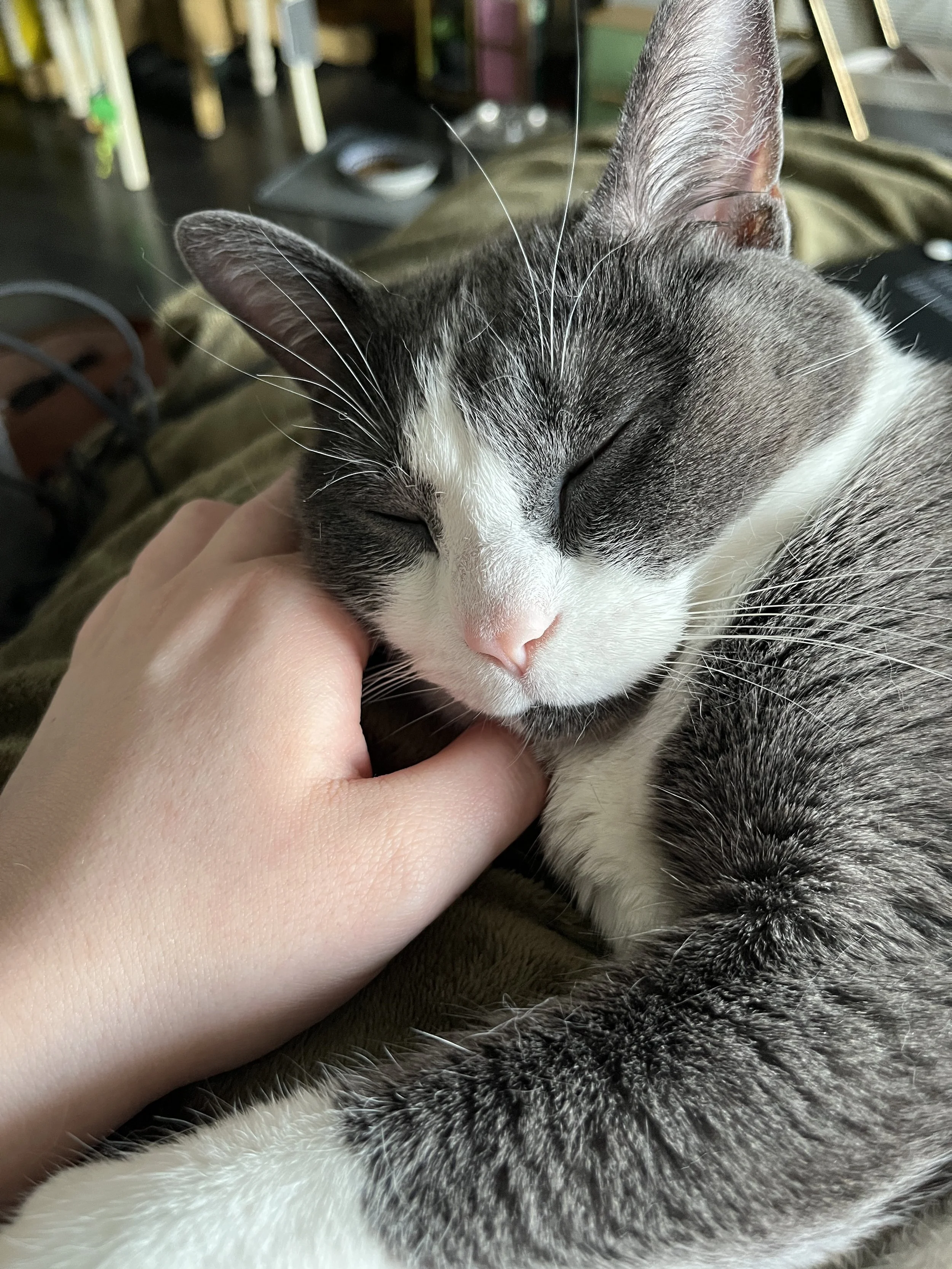
A low-demand day with the cats does not require explanation. It does not require performance, justification, or the energy of being understood. Lucy appears on the difficult days without being asked, settles in nearby, and stays. Jerri brings the lighter version of the same thing, a presence that is warm and occasionally ridiculous and entirely uncomplicated.
The comfort of company from my girls that asks nothing of you and offers something anyway is not a small thing when burnout has made every other form of connection feel like it requires more than you have.
Finding Connection through Comedy
When the goal is feeling seen rather than receiving advice, migraine and chronic illness memes do something that clinical resources cannot. The comedy of recognition, the specific relief of laughing at something that is also genuinely hard, provides a kind of validation that is immediate and requires nothing in return.
Looking for migraine memes or burnout reels during a low period is not avoidance. It is finding the version of community that matches what you actually need in that moment: to feel less alone, without having to explain yourself to get there.
What Migraine Burnout Is Not
It is not a failure to manage your condition well enough. It is not a weakness. It is not evidence that you are doing something wrong.
It is a predictable response to an unrelenting demand. It happens to people who are managing carefully, tracking diligently, doing everything they have been told to do, and still running out of capacity. The condition causes the burnout. The burnout is not a character flaw.
Recognizing it as burnout rather than personal failure is not just a reframe. It is the beginning of being able to recover from it.
FAQs
-
Migraine burnout is the physical, emotional, and cognitive exhaustion that develops from managing a chronic migraine condition over a sustained period. It is distinct from the exhaustion of individual attacks and develops from the cumulative load of tracking, managing, explaining, treating, and living around a condition that never fully resolves. It is a recognised experience within the chronic illness community and is associated with treatment fatigue, hypervigilance, and the emotional cost of invisible illness.
-
Regular burnout tends to be contained to a specific domain, most commonly work, and has a more identifiable cause and path out. Migraine burnout impacts every area of life simultaneously because the condition itself cuts across all of them. The financial, emotional, physical, and time costs of managing chronic migraine compound over months and years in a way that work burnout typically does not, and the path out does not involve removing the source of the demand because the source is a permanent condition.
-
Yes. Research supports the connection between chronic pain conditions and burnout, and chronic migraine specifically involves the sustained demands of ongoing management, treatment decisions, and the emotional load of an invisible condition. The American Migraine Foundation notes the significant overlap between chronic migraine, depression, and anxiety, all of which are both contributors to and consequences of sustained burnout.
-
Cephalalgiaphobia is the fear and anxiety cycle that develops around anticipating the next migraine attack. It is characterised by a persistent background dread of when the next attack will arrive, particularly before events or situations that require reliable functioning. It is a recognised feature of chronic migraine and contributes to the hypervigilance that makes migraine burnout more likely over time.
-
Recovery from migraine burnout typically involves temporarily stepping back from active management rather than intensifying it. This might include putting tracking tools away for a period, carving out time for activities that are entirely disconnected from your condition, giving yourself permission to exist without optimising, and finding connection with others who understand the experience. Recovery is not linear and does not look the same for everyone, but it begins with recognising that burnout is a response to an unrelenting demand, not a failure to manage well enough.
-
Yes. Burnout is associated with elevated cortisol and sustained stress, both of which are documented migraine triggers. The stress-migraine cycle post covers the bidirectional relationship between stress and migraine frequency in detail. Burnout that goes unaddressed creates a compounding cycle where increased migraine frequency contributes to more burnout, which increases migraine frequency further.
When should I seek professional support for migraine burnout?
If what you are experiencing has persisted for several weeks, is affecting your ability to function across multiple areas of your life, or feels like more than exhaustion, speaking with your GP or a mental health professional is worth prioritising. The emotional flattening and loss of motivation that comes with burnout can develop into depression, and that transition is easier to address early than after it has established itself. Burnout is not a character flaw and neither is needing support to move through it.
The content on this page is based on personal experience and is not medical advice. Always consult your doctor regarding your migraine management and treatment plan.
QUICK ANSWER: Migraine burnout is the exhaustion that comes from managing a chronic neurological condition that never fully resolves. Unlike regular burnout, which tends to be contained to one area of life, migraine burnout impacts everything simultaneously: the physical management, the emotional weight, the financial cost, the hypervigilance, and the grief of a condition that keeps demanding more than you have left to give. It is a predictable response to an unrelenting demand, not a failure to manage well enough.
